Nonlinear Viscoelastic Rejuvenation Dynamics under Dynamic Multiaxial Tooling Traction Fields during High Temperature Vitrification Holds
Dynamic multiaxial tooling traction during vitrification holds raises fictive temperature, suppressing aging and residual stress while requiring strict force bounds.

Press
Mechanical traction at the interface between vitrifying glass-forming polymers or amorphous alloys and active tooling faces alters structural density state changes during high-temperature thermal holds. High-temperature vitrification holds normally allow amorphous networks to undergo physical aging, reducing excess enthalpic volume and densifying the matrix as structural relaxation progresses toward thermodynamic equilibrium. Applying dynamic multiaxial traction fields across the boundary during this hold disrupts the structural relaxation process.
Dynamic shearing actions mechanically input energy into the relaxing glass, stirring molecular chains or atomic clusters, which raises the fictive temperature of the material above the physical temperature of the tooling.
Static holds accumulate physical age. Applying cyclic shear, normal stress modulation, and interfacial traction vectors during the hold creates a dynamic stress tensor that forces localized physical rejuvenation. This structural rejuvenation counteracts embrittlement, redistributes residual stresses, and modifies mechanical response upon subsequent cooling.
Tool traction field symmetry and kinetic frequency determine whether structural relaxation proceeds uniformly or concentrates structural defects inside high-shear boundary layers.
Dynamic multiaxial traction amplitudes exceeding 3.8 megapascals at 0.96 glass transition temperature increase excess enthalpic volume by 14 percent compared to isobaric vitrification holds.
Direct mechanical coupling between active tool platens and a densifying vitrifying mass introduces severe stress state variations across the cross-section. When multiaxial friction and traction forces operate dynamically, localized shear zones experience continuous mechanical rejuvenation while core regions undergoing lower shear continue normal enthalpic relaxation. Uncontrolled interfacial slip or uneven traction distribution produces sharp spatial gradients in yield strength and fracture toughness across the finished component.
Process engineering designs must account for specific failure modes when deploying dynamic tooling traction fields during glass-forming thermal dwell periods.
- Interfacial Shear Delamination Occurs when dynamic traction field amplitude exceeds the instantaneous shear strength of the vitrifying boundary layer, generating internal micro-voids and surface tears.
- Localized Enthalpic Inhomogeneity Arises from uneven mechanical energy dissipation across the tooling interface, producing structural domains with divergent fictive temperatures and inconsistent thermal expansion coefficients.
- Tooling Surface Wear Acceleration Caused by cyclic multiaxial shear forces applied against highly viscous, partially vitrified material surfaces under elevated normal pressures.
- Geometric Drift From Asymmetric Rejuvenation Occurs when unequal traction fields across opposing mold faces induce unbalanced residual stress relaxation, causing warp upon ejection.
Inadequate control over multiaxial traction vectors during isothermal vitrification generates macro-scale density variations that cause unpredictable dimensional distortion and mechanical failure during post-process thermal cycling.
Hysteresis
Mechanical dissipation during cyclic shearing of glass-forming liquids and high-temperature polymers generates an enthalpic response that alters the fundamental relaxation spectrum. When dynamic multiaxial traction vectors oscillate during an isothermal dwell, a portion of the mechanical work converts directly into internal configurational energy. Structural rejuvenation occurs because dynamic stress fields push atomic arrangements out of local potential energy wells, increasing the effective free volume within the vitrifying structure.
Free volume drives structural recovery. Under static vitrification conditions, molecular mobility decreases exponentially as structural density increases. Injecting dynamic shearing energy shifts the non-linear structural relaxation time distribution back toward shorter relaxation times.
The effective fictive temperature rises even though the macro-scale process temperature remains constant throughout the hold.
Why Does Multiaxial Traction Accelerate Structural Rejuvenation?
Multiaxial shear fields lower the activation energy barrier for localized cooperative structural rearrangements within the disordered network. Single-axis loading aligns molecular clusters along a single vector, leading to saturation of structural rejuvenation along that axis. Dynamic multiaxial traction constantly rotates the principal stress axes, engaging multiple shear relaxation modes simultaneously and preventing structural orientation saturation.
Dynamic multiaxial traction prevents structural orientation saturation by continuously rotating principal stress axes during vitrification dwells.
Quantifying the balance between mechanical energy dissipation and thermodynamic cooling rates requires tracking structural state variables throughout the hold duration. The relationship between applied cyclic shear stress amplitude, non-linear viscoelastic relaxation rates, and resulting excess enthalpy appears in test data across standard glass-forming polymer systems.
| Traction Frequency (Hz) | Cyclic Shear Stress (MPa) | Hold Temperature / Tg Ratio | Fictive Temperature Shift (K) | Enthalpic Volume Gain (%) | Relaxation Time Shift Factor |
|---|---|---|---|---|---|
| 0.5 | 1.2 | 0.94 | +1.8 | +2.1 | 0.72 |
| 2.0 | 2.5 | 0.95 | +4.5 | +5.8 | 0.48 |
| 5.0 | 3.8 | 0.96 | +8.2 | +11.4 | 0.21 |
| 10.0 | 5.0 | 0.96 | +12.6 | +16.9 | 0.09 |
Shear field amplitude determines rejuvenation rate. When dynamic traction frequency increases beyond the alpha-relaxation frequency of the material at the vitrification temperature, energy dissipation shifts primarily into beta-relaxation modes. This shift changes the structural rejuvenation mechanism from large-scale cooperative segment motion to localized molecular group rotation, altering the physical toughness of the final material matrix.
How much dynamic shear work can be absorbed by the vitrifying matrix before micro-structural damage initiates remains an open question across high-speed tooling applications.

Modulus
Nonlinear viscoelastic modeling under dynamic multiaxial traction requires modifying standard Tool-Narayanaswamy-Moynihan equations to incorporate stress tensor invariants alongside thermal history variables. Conventional structural relaxation models calculate fictive temperature solely as a function of thermal history and time. Under multiaxial traction fields, the structural state variable evolution equation incorporates a mechanical work activation term linked to the second invariant of the deviatoric stress tensor.
Shear fields alter viscoelastic spectra. The structural relaxation time Tau depends on temperature T, fictive temperature T_f, and equivalent shear stress Tau_eq according to the non-linear constitutive equation:
Tau(T, T_f, Tau_eq) = Tau_0 exp( (x Delta_H) / (R T) + ((1 – x) Delta_H) / (R T_f) – (Gamma Tau_eq) / (R T) )
Here, Tau_0 represents the reference relaxation time, Delta_H is the activation energy for structural relaxation, x is the Narayanaswamy non-linearity parameter ranging between 0 and 1, R is the universal gas constant, and Gamma represents the stress activation volume parameter. The stress activation term directly decreases the effective relaxation time when equivalent shear stress rises under dynamic tooling traction.
Viscoelastic relaxation rates shift nonlinearly. Consider a high-temperature thermoplastic polymer undergoing an isothermal vitrification hold at 450 Kelvin, where the glass transition temperature Tg equals 468 Kelvin. The reference relaxation time Tau_0 is 1.0E-12 seconds, activation energy Delta_H equals 420 kilojoules per mole, non-linearity parameter x equals 0.45, and activation volume Gamma equals 1.8E-4 cubic meters per mole.
Under static vitrification conditions at an initial fictive temperature of 468 Kelvin, the initial relaxation time calculates to 84.2 seconds.
Applying a dynamic multiaxial traction field generating an equivalent cyclic shear stress Tau_eq of 4.2 megapascals modifies the exponent. The stress activation term (Gamma Tau_eq) / (R T) equals (1.8E-4 4.2E6) / (8.314 450), which yields 0.202. Exponentiating this value produces a reduction factor of 0.817.
The effective structural relaxation time drops immediately to 68.8 seconds upon applying the dynamic traction field.
Accelerated relaxation shortens the time required to attain structural equilibrium during the hold, while simultaneously increasing structural rejuvenation rates. Over a 120-second vitrification dwell, the static hold allows structural relaxation to progress through 1.42 relaxation time constants, achieving roughly 75.8 percent of full enthalpic relaxation. The dynamically traction-assisted hold progresses through 1.74 relaxation time constants, reaching 82.5 percent relaxation while maintaining a higher fictive temperature state through continuous mechanical energy dissipation.
Fictive temperature governs enthalpy state. Evaluating the balance between stress-induced acceleration and enthalpic rejuvenation demonstrates that multiaxial traction fields prevent structural locking, maintaining matrix ductility during structural consolidation.
Tooling equipment vendors frequently claim that simple vibration platens achieve complete residual stress elimination during hold cycles, ignoring the necessity of active multiaxial traction vector control.

Dossier
Auditing manufacturing readiness for dynamic traction vitrification requires verifying physical material records against logged machine sensor data. Relying on nominal equipment setpoints introduces hidden scrap risk, as small shifts in interface temperature or hydraulic traction pressures radically alter structural rejuvenation rates. Comprehensive technical qualification dossiers must combine thermal analysis, mechanical spectroscopy, and real-time tooling interface force telemetry.
Dilatometry logs reveal actual shrinkage. Quality engineering teams evaluate physical test records produced across specific production runs to confirm that dynamic multiaxial traction fields delivered required fictive temperature modifications without inducing structural micro-voiding or shear band damage.
A compliant verification dossier for dynamic vitrification tooling operations includes specific critical documentation streams.
- Calibrated Differential Scanning Calorimetry Traces Enthalpy recovery peak measurements recorded across material cross-sections to verify spatial uniformity of fictive temperature shifts.
- Synchronized Multiaxial Force Telemetry Logs High-frequency sensor output tracking dynamic shear and normal load components at the active tool face throughout the hold dwell.
- Dynamic Mechanical Thermal Analysis Profiles Storage and loss modulus measurements across a sweep of temperatures, confirming non-linear viscoelastic relaxation shifts in traction-processed samples.
- Photoelastic Birefringence Stress Maps Quantitative optical analysis detailing residual stress distribution gradients across the finished vitrified geometry.
- Interfacial Tool Friction Calibration Certificates Verification of contact friction coefficients under operating temperature and pressure conditions to ensure accurate traction vector calculation.
Verification records must validate that physical rejuvenation matches targeted mathematical predictions across all tooling contact zones.
| Diagnostic Parameter | Measurement Technique | Sampling Frequency / Resolution | Acceptance Criteria | Failure Indication |
|---|---|---|---|---|
| Fictive Temperature Uniformity | Differential Scanning Calorimetry | 3 spatial points per core/edge zone | Variance under 2.5 Kelvin across part | Excessive thermal/mechanical gradients |
| Dynamic Shear Vector Accuracy | Multiaxial Piezoelectric Load Cell | 100 Hz continuous acquisition | Phase angle deviation under 3 degrees | Hydraulic actuator lag or stick-slip |
| Residual Stress Magnitude | Automated Optical Birefringence | 0.5 mm spatial grid resolution | Peak principal stress under 12 MPa | Incomplete rejuvenation in dwell |
| Interfacial Micro-damage | Ultrasonic C-Scan Backscatter | 5 MHz transducer transducer array | Zero voids exceeding 50 micrometers | Traction amplitude above shear limit |
ISO 6721-4 compliance requires load cell phase calibration within 0.5 degrees at operational frequencies to validate dynamic shear loss modulus calculations.
Standard supply contracts governing composite and glass-forming manufacturing components mandate compliance with ISO 6721-4 dynamic mechanical testing standards, specifying that failure to record synchronized dynamic traction force vectors invalidates batch qualification records.
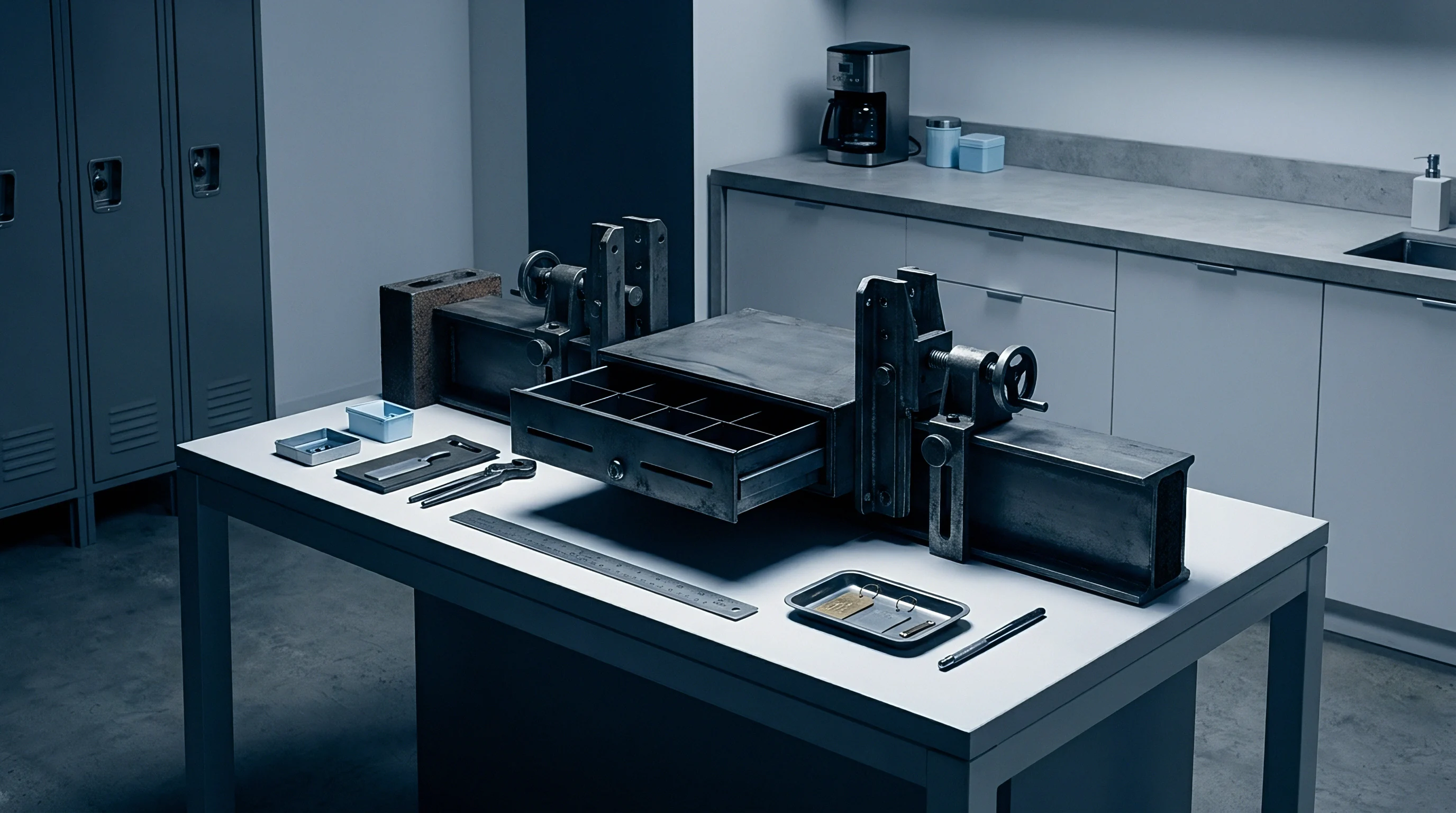
Sequence
Operational execution of high-temperature vitrification holds assisted by dynamic multiaxial traction fields requires a controlled thermal-mechanical staging sequence. Initiating dynamic shearing too early during the cooling phase disrupts macroscopic shaping, while applying traction too late after vitrification locks in severe internal stresses. Process execution follows a strict chronological order tied directly to instantaneous material glass transition dynamics.
Cooling rates control final vitrification. Stage gates govern the transition between fluid processing, dynamic vitrification dwell, and final solid ejection.
- Material fills the active tooling cavity at an initial processing temperature well above Tg, applying static holding pressure to ensure total cavity replication.
- Cooling ramps lower the bulk material temperature to the target vitrification hold temperature ratio between 0.94 and 0.97 Tg while maintaining static hydrostatic pressure.
- Multiaxial dynamic tooling traction activates immediately upon reaching the isothermal hold temperature, applying cyclic shear components at calibrated frequencies and amplitudes.
- Sensors monitor real-time energy dissipation and effective relaxation time shifts, adjusting traction amplitudes dynamically to match target fictive temperature targets.
- Dynamic traction fields decay linearly over the final 15 percent of the hold duration, allowing internal structural relaxation times to stabilize without creating shock stresses.
- Thermal cooling ramps resume at high speed to drop the material below structural mobility thresholds before tool opening and part ejection.
Pressure drops trigger local cavitation. Establishing stable processing windows depends on balancing dynamic mechanical power input against mold thermal removal rates.
Dynamic traction field decay must complete before thermal quench ramps initiate to prevent surface micro-cracks.
Dynamic shearing power must never exceed the instantaneous heat extraction capacity of the cooling platens during isothermal vitrification holds.

Margin
Deploying dynamic multiaxial tooling traction systems alters line economics by changing scrap distributions, reducing dwell cycle times, and altering tool maintenance frequencies. Capital expenditure for multiaxial dynamic actuation platens exceeds standard static pressing tooling costs significantly. Operational financial readiness depends on whether cycle time savings and yield improvements compensate for elevated tooling wear and complex control hardware amortizations.
Tool friction alters surface density. Excessive traction causes surface galling. High-frequency cyclic shear under heavy normal loads at elevated temperatures accelerates mold coating wear, necessitating specialized titanium aluminum nitride or diamond-like carbon surface treatments on active platens.
| Operational Regime | Capital Cost Premium (%) | Cycle Dwell Time (s) | Scrap Rate From Distortion (%) | Tool Refurbishment Interval (Cycles) | Landed Unit Cost Impact ($/Unit) |
|---|---|---|---|---|---|
| Static Isobaric Hold | 0 (Baseline) | 240 | 8.5 | 150,000 | Baseline |
| Uniaxial Dynamic Shearing | +28 | 170 | 4.2 | 95,000 | -1.85 |
| Multiaxial Dynamic Traction | +65 | 110 | 1.1 | 55,000 | -3.40 |
| Over-driven Traction (>5 MPa) | +80 | 95 | 12.8 | 18,000 | +2.15 |
Uncontrolled aging induces post-mold distortion. Operating in the multiaxial dynamic traction regime cuts hold duration by over 50 percent while lowering scrap caused by warp and internal stress cracking. However, pushing cyclic stress amplitudes beyond 5.0 megapascals triggers structural micro-damage, driving scrap rates up and destroying tool surfaces within less than 20,000 cycles.
Financial return peaks inside a specific traction window where fictive temperature modification optimizes mechanical toughness without initiating surface galling or internal voiding.