Thermodynamic and Mechanical Coupling Models for Multi Zone Constrained Post Cure Tooling
Multi zone constrained post cure models prevent part distortion by balancing spatial thermal gradients against cure dependent viscoelastic stress relaxation rates.

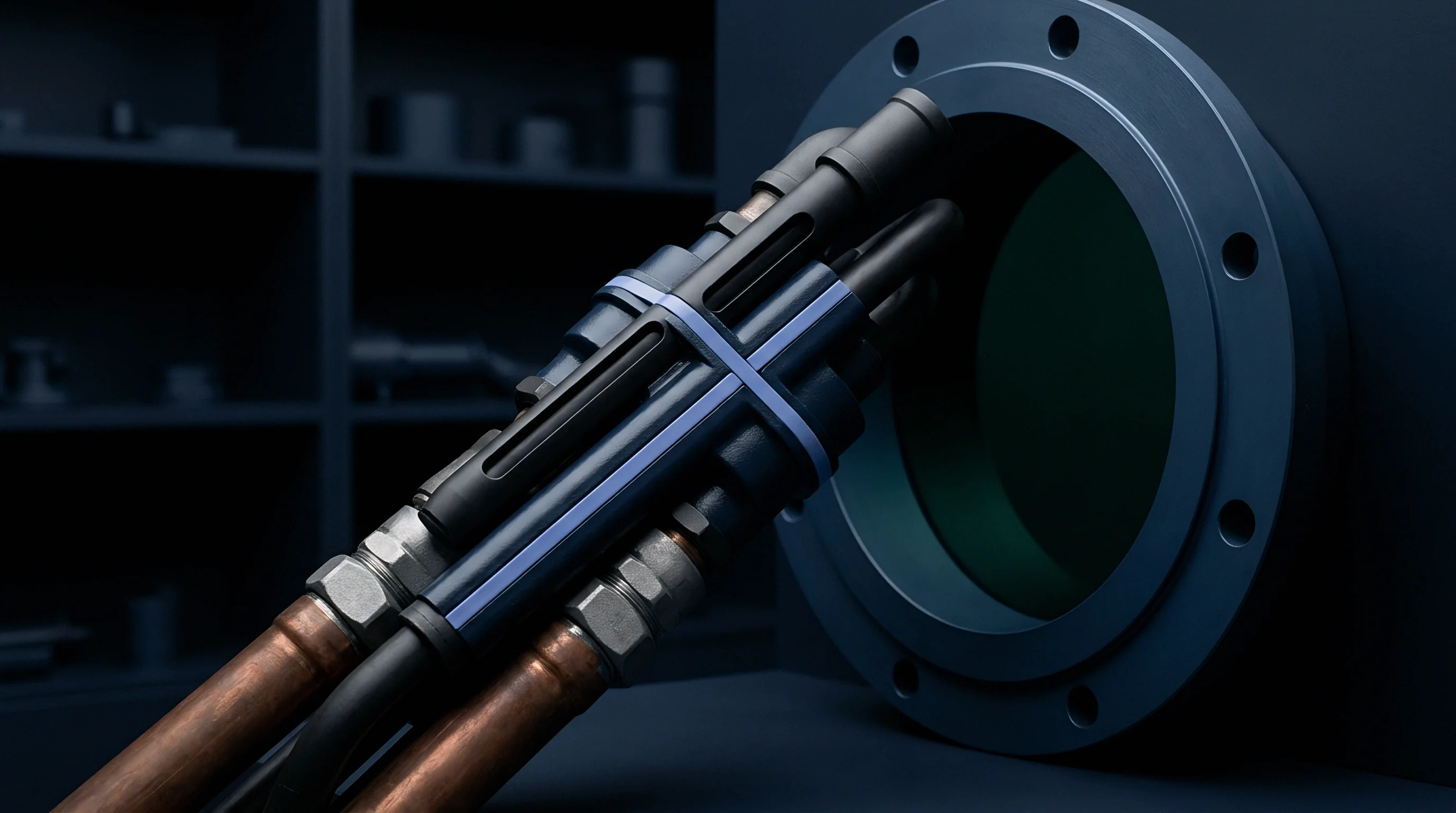
Swell
Thermal Expansion and Volumetric Shrinkage Dynamics
Post-cure processing converts a partially cured, gelled composite structure into a cross-linked lattice that can maintain design tolerances under load. At this stage, two physical phenomena compete: heat expands the matrix and reinforcement fibers according to their thermal expansion coefficients, while covalent bond formation pulls monomer units closer together, causing volumetric shrinkage. In unconstrained post-cure setups, these opposing forces cause out-of-plane warpage and angular spring-back.
Constrained tooling restricts this movement by enforcing boundary conditions through mechanical clamps, hydraulic platens, or matched-die cavities.
Mechanical constraint alters the laminate’s internal stress state during the elevated temperature cycle. Inside a rigid metallic tool frame, boundary constraints force thermal expansion of the resin into internal hydrostatic and deviatric compression. As the degree of cure moves from gelation toward full cross-linking, the glass transition temperature of the matrix climbs continuously.
If the process temperature stays below this evolving threshold, the matrix acts as a glassy solid with a high elastic shear modulus. Thermal expansion against a rigid steel or Invar tool wall then generates compressive stresses high enough to crush surface fibers or form micro-buckling flaws.
Tooling material selection governs the baseline displacement imposed on the composite assembly. Standard carbon steel tools display an isotropic thermal expansion coefficient near 12 micro-strain per degree Celsius, whereas aerospace carbon prepreg laminates exhibit near-zero longitudinal expansion alongside transverse expansion rates exceeding 30 micro-strain per degree Celsius above their gel point. The resulting strain mismatch forces sliding friction across the tool-part interface.
Under mechanical clamping, this interfacial friction acts as a secondary lateral constraint, pinning surface plies while core plies expand or contract independently.

Glass Transition Phase Shifts under Physical Restraint
The transition between rubbery and glassy states alters how the matrix responds to multi-zone thermal inputs. When the ramp elevates tool temperature above the instantaneous glass transition mark, segmental mobility within the polymer network increases. The shear modulus drops by two to three orders of magnitude, allowing the matrix to flow plastically and relieve internal stresses from mechanical clamping.
This stress relief is temporary: as cross-linking continues at the hold temperature, network density rises, driving the glass transition temperature back above the local tool temperature and vitrifying the matrix while under confinement.
Vitrifying under constraint traps the spatial configuration established by the tooling geometry. If surface temperatures remain non-uniform across active heating zones during vitrification, adjacent regions transition at different times. Zones subjected to higher thermal flux complete cross-linking earlier, locking their localized strain states while cooler areas remain compliant.
When those cooler regions eventually vitrify, they lock in a different volumetric strain state, creating frozen-in stress gradients across the part length that cause dimensional distortion once boundary constraints are released at room temperature.
Improperly set mechanical boundary constraints during volumetric resin expansion lead directly to surface micro-cracking, crushed interface faces, and permanent out-of-roundness exceeding standard structural assembly allowances.

Zones

Thermal Boundary Architecture and Zone Cross-Talk
Multi-zone heating systems manage spatial thermal fields by dividing large tool surface areas into individually monitored and powered thermal control circuits. Each zone relies on embedded resistive heating elements, fluid channels, or induction coils to deliver local heat flux based on real-time sensor feedback. Because solid tool steels and aluminum alloys have high thermal conductivity, thermal energy applied to one heating zone conducts laterally into adjacent regions, creating thermal cross-talk that destabilizes neighboring control loops.
This cross-talk complicates control algorithms designed to enforce continuous spatial isothermality during post-cure ramps. Tooling perimeters lose thermal energy through radiation and convection to ambient factory air, requiring higher energy input than central zones. Without decoupled multi-variable control models, perimeter zones overshoot their targets while compensating for edge losses, driving thermal conduction backward into interior zones, which then throttle down and create localized cold spots that retard chemical cure advancement.
| Zone Location | Convective Heat Loss (W/m²K) | Lateral Conduction Flux (kW/m²) | Target Ramp Rate (°C/min) | Observed Thermal Lag (s) |
|---|---|---|---|---|
| Perimeter Edge | 22.5 | 4.8 | 1.5 | 140 |
| Interior Platen | 8.2 | 1.2 | 1.5 | 45 |
| Structural Rib Interface | 14.1 | 6.3 | 1.5 | 210 |
| Vacuum Port Center | 6.8 | 0.9 | 1.5 | 30 |

Convective and Conductive Heat Sink Anomalies
Heavy structural support ribs beneath the tool face act as localized heat sinks, distorting the thermal footprint generated by multi-zone heating elements. Steel stiffeners welded or bolted to the tool plate draw heat away from the working surface, creating localized low-temperature regions directly above rib intersections. If the control architecture fails to isolate these high-mass zones with dedicated heating circuits and fine-grained sensors, the laminate directly above the stiffener experiences delayed cure advancement relative to the surrounding skin.
A multi-zone tool operating with a 15-degree spatial variation across zone boundaries during vitrification generates residual stress spikes exceeding 42 megapascals in carbon/epoxy laminates.
Managing surface boundary conditions requires real-time calculation of conductive heat transfer tensors through the tool skin thickness, alongside convective boundary modeling along the tool back-face. High-velocity air circulation in forced-convection post-cure ovens dynamically alters exterior heat transfer coefficients based on fan speed and spatial baffle arrangements. When tooling arrays feature tight internal channels, localized stagnation zones lower convective heat transfer rates, forcing those areas to rely primarily on conduction through the tool body.
- Uncompensated Edge Conduction induces localized thermal gradients that retard cross-linking along structural flanges while central panel zones achieve full vitrification.
- Cross-Talk Oscillation Loop occurs when adjacent zone controllers drive complementary power swings, creating standing thermal waves across the tool surface.
- Thermal Mass Asymmetry causes delayed temperature response above thick tool support ribs, generating internal shear strain between skin plies and underlying stiffener zones.
- Convective Shadowing Effects restrict heat transfer rates along tool underside pockets, driving top-to-bottom thermal deltas that skew the mechanical neutral axis.
Increasing thermal zone density is often intended to guarantee spatial temperature uniformity, but uncalibrated multi-variable controllers can induce resonant thermal oscillations across conductive metal platens.

Mechanics

Coupled Thermo-Chemo-Viscoelastic Formulations
Modeling structural stress during constrained post-cure requires integrating thermal expansion, chemical shrinkage, and cure-dependent viscoelasticity into a unified constitutive stress-strain tensor equation. The total incremental strain tensor consists of distinct mechanical, thermal, and chemical components added linearly under small-strain mechanics assumptions:
dε = dε_elastic + dε_viscoelastic + dε_thermal + dε_shrinkage
The elastic and viscoelastic compliance tensors depend directly on temperature and the degree of cure. Early in the cure cycle, the matrix exhibits low shear stiffness, allowing rapid relaxation of stresses caused by thermal expansion. As the chemical reaction proceeds, the relaxation time spectrum shifts toward longer durations.
When the material vitrifies, relaxation times expand beyond the duration of the post-cure cycle, freezing residual stresses permanently into the polymer backbone.

Why Do Viscoelastic Relaxation Time Scales Shift under Constrained Volumetric Thermal Expansion?
Free volume theory explains why relaxation spectrum shifts occur under physical restraint. Volumetric thermal expansion increases internal free volume between polymer chains, accelerating segmental mobility and shortening characteristic relaxation time scales. Rigid mechanical constraints counteract this volume expansion, physically compressing the polymer network and maintaining a low free volume state despite elevated thermal energy.
Consequently, the material retains longer relaxation times than an unconstrained sample at the same temperature, suppressing stress relaxation and allowing high mechanical stresses to persist throughout the thermal hold.
| Property Parameter | Rubbery State Value | Glassy State Value | Measurement Standard |
|---|---|---|---|
| Unidirectional Modulus E11 (GPa) | 125.0 | 138.0 | ASTM D3039 |
| Transverse Modulus E22 (GPa) | 0.45 | 9.80 | ASTM D3039 |
| In-Plane Shear Modulus G12 (GPa) | 0.18 | 4.60 | ASTM D3518 |
| Longitudinal CTE alpha_11 (µm/m·K) | -0.2 | -0.5 | ASTM E228 |
| Transverse CTE alpha_22 (µm/m·K) | 85.0 | 28.0 | ASTM E228 |
| Volumetric Chemical Shrinkage (%) | 1.80 | 0.15 | ASTM D2734 |
Time-temperature-cure superposition models capture this behavior by modifying shift factors based on thermal potential and cross-link density. Standard Williams-Landel-Ferry equations describe relaxation behavior above the glass transition point, but transition to Arrhenius-type relationships below vitrification. Incorporating hydrostatic pressure dependencies into shift factor equations allows numerical simulations to accurately predict stress accumulation under multi-axis rigid boundary constraints.
Viscoelastic relaxation rates drop exponentially once matrix vitrification locks the polymer chain mobility under spatial mechanical restraint.
Tool-part interfacial shear stress models must account for temperature-dependent friction coefficients and tool surface roughness. As the composite expands against a metallic tool surface under high clamping force, interfacial friction inhibits lateral movement. This friction-induced shear strain introduces an asymmetric stress state across the part thickness, producing warp vectors upon demolding that finite element models assuming frictionless contact fail to predict.
A major unresolved question in current constitutive modeling is how multi-axial hydrostatic pressure states alter instantaneous chemical reaction rates during high-pressure post-cure holds.

Audit
Sensor Topology and Empirical Validation Protocols
Validating thermo-mechanical coupling models requires empirical data collected within the constrained tool cavity during active processing. Fiber-optic Bragg grating sensors embedded between laminate plies measure localized strain development and internal thermal fields simultaneously. Standard thermocouples on the tool surface supply boundary temperature inputs, but fail to report internal thermal lag within thick composite sections.
Strain measurements obtained during post-cure processing require careful decoupling of thermal expansion from mechanical and chemical strains. Optical fiber sensors detect refractive index changes caused by both temperature shifts and axial mechanical strain. Installing dual-fiber configurations ~ where one unbonded fiber inside a micro-capillary tube registers temperature alone while an adjacent bonded fiber registers total strain ~ isolates the mechanical stress component across the post-cure profile.
Standard aerospace quality assurance mandates require thermal uniformity verification across all active tool zones to remain within a total envelope of 5.6 degrees Celsius during post-cure holds.
Model calibration relies on comparing predicted finite element stress distributions with experimental residual strain profiles measured post-demolding. High-resolution optical surface profiling combined with destructive ring-cut or incremental hole-drilling techniques yields empirical stress profiles across the laminate thickness. Discrepancies between modeled spring-back angles and physical geometries highlight inaccuracies in the assumed viscoelastic relaxation spectrum or friction coefficients along tool contact faces.
- Spatial Sensor Placement Mapping requires positioning fiber-optic strain arrays along maximum thermal gradient boundaries identified during preliminary thermal analysis.
- Free Strain Reference Baseline establishes pure thermal expansion curves using unconstrained composite coupons cured in parallel under identical thermal profiles.
- Tool Friction Characterization determines sliding resistance coefficients across the complete temperature range using direct shear test fixtures under representative clamping loads.
- In-Situ Temperature Calibration verifies that embedded fiber Bragg grating sensors match calibrated resistance temperature detectors within 0.2 degrees Celsius across the operating thermal window.
- Post-Demolding Warp Reconstruction captures three-dimensional surface profiles using laser scan arrays within two hours of constraint release to baseline elastic spring-back.
Under standard aerospace procurement terms based on specification AMS 2750 for pyrometry, any post-cure tooling assembly demonstrating spatial temperature variations exceeding 5.6 degrees Celsius across active zones during hold steps incurs mandatory lot rejection and re-qualification auditing.

Sequence
Thermal Ramp and Constraint Activation Scheduling
Managing residual stress buildup in constrained post-cure tooling depends on the timing of thermal ramp rates and constraint application. Applying high mechanical clamping forces before the matrix gels forces liquid resin out of the laminate, causing resin starvation and localized dry spots. Delaying constraint application until after matrix vitrification prevents the tooling from enforcing design geometry, allowing unrestrained thermal expansion to distort the final part envelope.
Optimized post-cure schedules employ multi-stage heating profiles with controlled dwell steps to harmonize thermal distributions throughout the tool mass before advancing reaction rates. Ramp rates between 0.5 and 1.5 degrees Celsius per minute prevent steep thermal gradients between thin outer skins and thick structural ribs. Dwell periods placed just below the initial glass transition point allow internal thermal lag to dissipate, ensuring the entire component crosses its phase boundaries uniformly.
Mechanical boundary conditions can be modulated dynamically throughout the post-cure schedule using automated hydraulic or electromechanical clamping mechanisms. Applying moderate constraint pressure during initial heat-up permits controlled thermal expansion while maintaining alignment. Once the profile reaches the designated isothermal hold plateau and cross-linking advances, clamping force increases to lock spatial geometry tightly during vitrification.
- Thermally equalize the tool and composite assembly by holding at initial gel temperature until all internal thermocouple locations show less than 1.5 degrees Celsius variance.
- Initiate the primary thermal ramp at a controlled rate not exceeding 1.0 degree Celsius per minute while maintaining low baseline hydraulic positioning force on boundary clamps.
- Engage full mechanical boundary constraints upon reaching the designated isothermal post-cure hold temperature prior to the onset of matrix vitrification.
- Maintain isothermal hold conditions until embedded dielectric sensors indicate cure reaction completion and glass transition stabilization.
- Execute controlled cooling at a maximum rate of 0.8 degrees Celsius per minute, maintaining full mechanical constraints until the assembly drops below 50 degrees Celsius.
- Disengage mechanical boundary constraints only after the internal tool temperature reaches ambient factory equilibrium to minimize thermal shock spring-back.
Dynamic monitoring of cure advancement via dielectric sensors allows adaptive hold times that guarantee complete vitrification before cooling begins.
A reliable operational rule of thumb indicates that lowering the final cooling ramp rate by half reduces internal residual shear stresses far more effectively than extending the high-temperature post-cure dwell time.


Capital

Tooling Investment Economics and Yield Optimization
Selecting a multi-zone post-cure tooling control architecture is a major capital investment decision that directly affects scrap rates and long-term manufacturing costs. Passive, single-zone metal tools carry lower upfront acquisition costs, but introduce substantial scrap risks on complex, thick-section composite components due to unmanaged thermal gradients and CTE mismatch stresses. Multi-zone active thermal tools demand a higher initial outlay for specialized heating controllers, multi-channel power switching units, and dense sensor networks, but deliver tight dimensional repeatability and high first-pass yield.
High-value aerospace carbon fiber structures subject to strict geometric tolerances cannot tolerate structural spring-back or localized surface distortion caused by poor post-cure thermal control. Scrap costs escalate rapidly when non-conforming parts undergo expensive machining before dimensional defects surface during final assembly inspection. Implementing closed-loop multi-zone thermal and mechanical coupling models during tool design eliminates iterative modifications, shortening time-to-market and protecting capital deployment schedules.
| Tooling Architecture Class | Initial Tool Capital Cost ($K) | Control System Complexity | Expected Scrap Rate (%) | Dimensional Variance Envelope (mm) |
|---|---|---|---|---|
| Passive Single-Zone Steel Tool | 120 | Low | 14.2 | +/- 1.85 |
| Passive Invar 36 Matched Tool | 380 | Low | 5.8 | +/- 0.65 |
| Active 8-Zone Heated Aluminum Platen | 240 | Medium | 3.4 | +/- 0.40 |
| Active 24-Zone Thermomechanically Controlled Invar | 590 | High | 0.6 | +/- 0.12 |
Evaluating the true financial return on advanced multi-zone tooling requires calculating total landed cost per acceptable unit over the entire production run. High capital outlay for fully active, thermomechanically compensated tooling amortizes rapidly across large production runs by driving scrap rates below one percent while reducing downstream shim requirements during structural integration.
Production facilities operating on tight operational margins cannot absorb repeated scrap events stemming from unmodeled thermo-mechanical spring-back defects.
- Part Geometric Complexity dictates whether passive material selection suffices or active multi-zone thermal management becomes necessary to meet tight drawing tolerances.
- Production Volume Amortization establishes the financial threshold where high initial tooling capital expenditure delivers a lower total cost per unit.
- Downstream Assembly Integration Costs drop significantly when tight dimensional control eliminates custom shimming and manual bench fitting during final structure joins.
- Scrap Material Loss Sensitivity scales directly with component size, raw prepreg material costs, and the cumulative labor value added prior to post-cure inspection.
Capital authorization for advanced multi-zone post-cure tooling relies on comparing the upfront cost of multi-channel power controllers and integrated sensor arrays against the cumulative financial impact of part scrap, rework labor, and assembly integration delays over the complete contract lifespan.