Post Molding Moisture Equilibrium in Polyamide Component Manufacturing
Post-molding moisture conditioning converts rigid dry polyamides into tough, dimensionally stable components using controlled water absorption.


Sorption
Molded polyamide components leaving an injection molding cavity exist in a dry-as-molded state with water concentration below 0.2 percent by weight. Polyamides absorb moisture rapidly. Polyamide 6 and polyamide 66 contain polar amide groups along their polymer backbone chains that form hydrogen bonds with absorbed atmospheric moisture.
This molecular water uptake alters the physical structure of the polymer matrix, shifting the glass transition temperature downward and altering mechanical performance.
Hydrogen bonds govern water absorption. In the dry-as-molded state, inter-chain hydrogen bonding between adjacent amide groups creates a rigid, high-modulus crystalline and amorphous network. As environmental moisture enters the free volume of the amorphous phase, water molecules bind preferentially to open carbonyl and amine sites.
This incoming water acts as a plasticizer. Polymer chains gain mobility, causing the glass transition temperature to drop from roughly 65 degrees Celsius in dry-as-molded polyamide 6 down to below 0 degrees Celsius upon reaching ambient moisture equilibrium.
The rate of moisture sorption follows Fickian diffusion kinetics during initial exposure stages, where total absorbed mass scales proportionally with the square root of time. Environmental conditions dictate the eventual moisture equilibrium level. Standard atmospheric conditioning at 23 degrees Celsius and 50 percent relative humidity results in a nominal moisture equilibrium of 2.5 to 3.0 percent by weight for unfilled polyamide 6, whereas polyamide 66 settles between 1.5 and 2.0 percent.
Complete immersion in water drives saturated absorption levels to approximately 9.5 percent for polyamide 6 and 8.5 percent for polyamide 66.
Chemical Structure and Equilibrium Limits
The chemical concentration of amide groups dictates the hydrophilic capacity of each polyamide variant. Polyamide 6 features six carbon atoms between amide linkages, producing a higher dipole density than polyamide 12, which contains twelve carbon atoms between linkages. Consequently, polyamide 12 absorbs less than 1.1 percent water at ambient equilibrium.
Reinforcing fillers reduce net moisture absorption proportional to their mass fraction by replacing hygroscopic resin volume with inert glass or mineral material.
| Grade Specification | Dry Glass Transition Temperature (C) | Equilibrium Water Content at 23 C / 50% RH (%) | Saturated Water Content in Water Bath (%) | Conditioned Glass Transition Temperature (C) |
|---|---|---|---|---|
| Unfilled Polyamide 6 | 65 | 2.8 | 9.5 | -5 |
| Unfilled Polyamide 66 | 70 | 2.0 | 8.5 | 5 |
| 30% Glass Reinforced PA6 | 68 | 1.9 | 6.5 | 0 |
| 30% Glass Reinforced PA66 | 72 | 1.4 | 5.8 | 10 |
Thermal energy speeds moisture ingress. Higher ambient processing temperatures elevate the diffusion coefficient according to Arrhenius relationships, enabling accelerated post-molding conditioning operations. Processing teams leverage elevated water bath temperatures to reach target equilibrium states in hours rather than the weeks required under room-temperature storage conditions.
Suppliers frequently attribute initial dimensional fit errors to unpredictable ambient humidity during customer storage rather than incomplete conditioning schedules on the molding floor.

Bath
Accelerating moisture absorption requires elevated temperature water bath immersion or high-humidity environmental chambers. Standard atmospheric conditioning takes several weeks for medium-wall industrial components to reach physical equilibrium. Accelerated immersion reduces residence times dramatically, converting month-long storage delays into manageable batch processing windows.
Diffusion rates drop in thick walls. Fickian diffusion equations dictate that the time required to reach a specific moisture concentration ratio scales with the square of part wall thickness. A component with a 4-millimeter nominal wall thickness requires four times longer to stabilize than a 2-millimeter wall component under identical temperature and humidity exposures.
Conditioning bath temperatures remain strictly below the wet glass transition threshold to prevent surface micro-voiding and localized resin degradation.
Water bath conditioning utilizes heated fluid reservoirs maintained between 70 and 80 degrees Celsius. Hot water accelerates molecular motion, driving water molecules deep into the core of thick sections. Immersing parts above 80 degrees Celsius introduces dimensional risks, as localized thermal gradients and rapid swelling induce surface stresses that cause permanent part warpage.
Immersion Failure Modes
Improperly managed accelerated water conditioning degrades both surface aesthetics and physical structural integrity. Maintaining rigorous bath temperatures, fluid filtration, and residence timing avoids severe material defects.
- Surface blistering occurs when immersion bath temperatures exceed the glass transition threshold of the wet outer polymer layer, forcing micro-cavitation.
- Anisotropic warpage arises when asymmetrical wall thicknesses absorb moisture at uneven rates across part geometries.
- Extractable leaching strips low-molecular-weight oligomers and plasticizing additives into hot water baths during extended high-temperature immersion.
- Extractable crystallization leaves white surface deposits of oligomeric residues on component faces upon drying.
Thick sections slow water diffusion. Bath agitation prevents localized thermal stagnation around densely packed component baskets. Fluid circulation maintains uniform temperature distribution throughout the tank, ensuring equal moisture uptake across every molded lot.
Conditioning bath temperatures remain strictly below the wet glass transition threshold to preserve surface finish integrity.

Distortion
Moisture sorption drives measurable volumetric expansion in polyamide components. Absorbed water molecules insert themselves between polymer chains, forcing the molecular network to expand outward. Mold shrinkage shifts dimensional baseline calculations, but moisture swelling partially reverses this initial contraction.
Linear swelling scales directly with absorbed moisture volume. Unfilled polyamide 6 expands linearly by approximately 0.2 to 0.3 percent for every 1.0 percent weight increase in absorbed moisture. Molders designing high-precision automotive structural parts compensate for post-molding moisture swelling during initial mold tool geometry calculations.
Unfilled polyamide 6 expands linearly by 0.25 percent for every 1.0 percent increase in moisture content under standard ambient exposure at 23 degrees Celsius.
Fiber alignment alters expansion symmetry. Glass-fiber reinforced polyamides display anisotropic dimensional swelling due to rigid fiber orientation. Polymer chains expand perpendicular to glass fiber alignment, while expansion along the primary fiber flow direction remains restricted.
Transverse linear expansion in 30 percent glass-reinforced PA66 often exceeds longitudinal expansion by a factor of four.
Mechanical Property Alterations
Moisture acts as an internal lubricant, reducing intermolecular forces between polyamide chain segments. Tensile strength and flexural modulus decrease significantly as moisture content rises toward equilibrium, while impact toughness and ultimate elongation increase substantially.
| Material Grade | Condition State | Tensile Modulus (MPa) | Flexural Strength (MPa) | Notched Izod Impact (kJ/m2) | Volumetric Expansion (%) |
|---|---|---|---|---|---|
| PA6 Unfilled | Dry-as-Molded | 3,100 | 110 | 4.0 | 0.00 |
| PA6 Unfilled | 50% RH Equilibrium | 1,400 | 50 | 11.0 | 0.70 |
| PA66 GF30 | Dry-as-Molded | 8,800 | 250 | 10.0 | 0.00 |
| PA66 GF30 | 50% RH Equilibrium | 6,000 | 170 | 14.0 | 0.35 |
| Data measured at 23 degrees Celsius. Conditioned equilibrium reflects ISO 1110 exposure standards. | |||||
Saturated surfaces expand faster than cores. Unconditioned parts fail impact tests easily. Sinking dry-as-molded parts directly into snap-fit assemblies causes mechanical fracture because the material lacks sufficient elongation.
Metrology reads false without stabilization.
Shipping dry-as-molded structural housings leads directly to assembly fit failure and high field warranty claims when parts absorb ambient moisture post-installation and expand past print tolerance limits.

Throughput
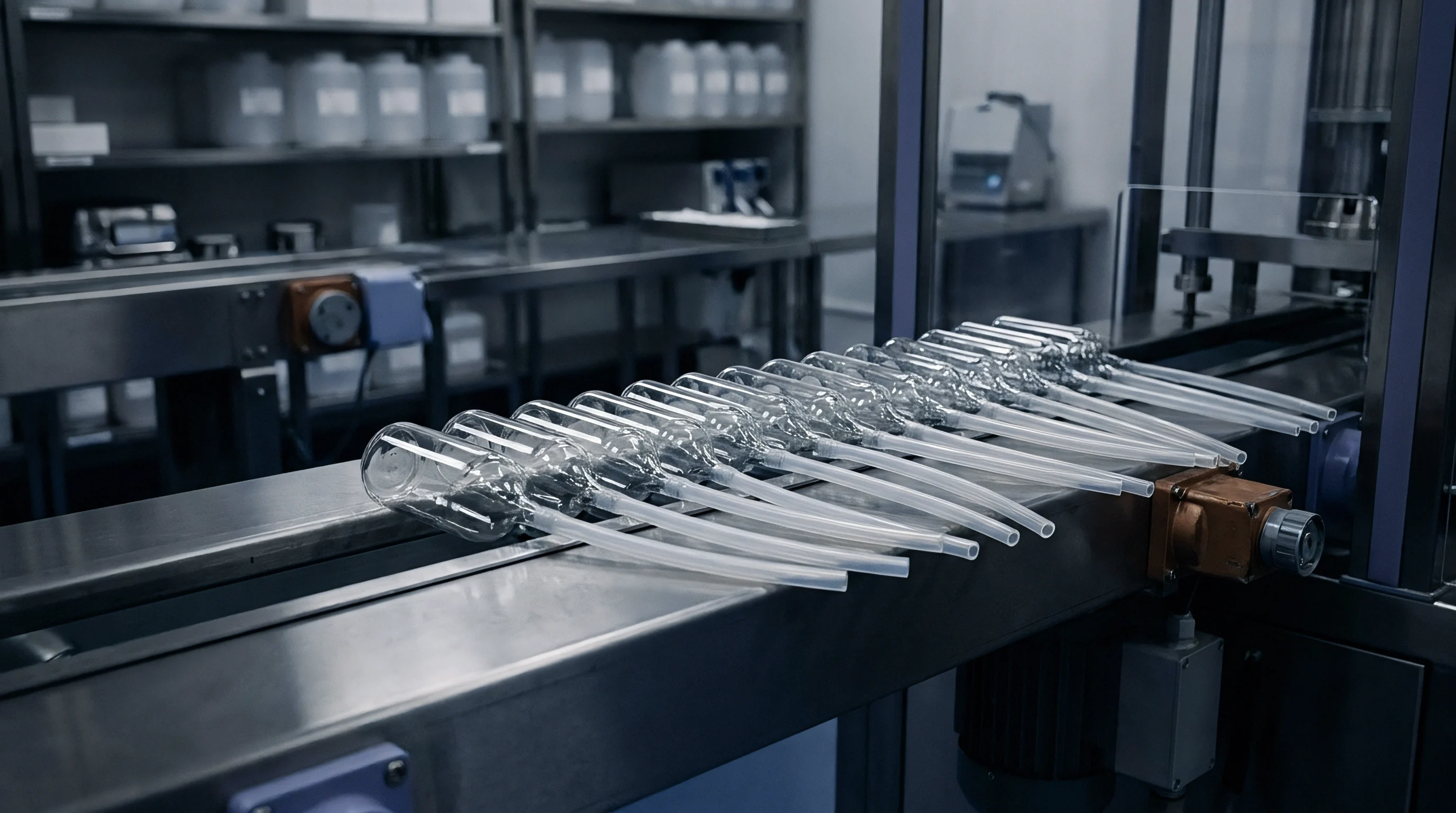
Conditioning dwell times create major inventory bottlenecks on plant floors. Injection molding presses yield finished components in seconds, but post-molding conditioning assets hold material for hours or days. Balancing press output against conditioning chamber capacity governs production floor footprint efficiency.
Buffer inventory holding costs accrue daily. Holding work-in-progress inventory for seven-day atmospheric stabilization cycles consumes valuable plant floor area and ties up working capital. High-volume manufacturing plants utilize continuous automated steam conditioning tunnels or batch hot water immersion systems to match press cycle throughput.
When Does Conditioning Chamber Residence Time Become the Primary Bottleneck?
Residence time dominates line logistics when part wall thickness exceeds 3 millimeters or daily press output surpasses offline conditioning vessel capacity. Calculating precise conditioning dwell times prevents inventory staging queues from blocking press output zones.
| Wall Thickness (mm) | Conditioning Method | Target Temperature (C) | Dwell Time to 50% RH Equilibrium | Required WIP Staging Footprint per Press (m2) |
|---|---|---|---|---|
| 1.5 | Hot Water Bath | 80 | 3 Hours | 4 |
| 1.5 | Atmospheric Rack | 23 | 14 Days | 45 |
| 3.0 | Hot Water Bath | 80 | 12 Hours | 12 |
| 3.0 | Atmospheric Rack | 23 | 40 Days | 120 |
ISO 1110 specifies accelerated conditioning of polyamide test specimens at 70 degrees Celsius and 62 percent relative humidity to achieve equilibrium state without thermal degradation.
Calculating necessary conditioning chamber throughput requires an established mathematical sizing sequence.
- Determine the total daily mass output by multiplying shot weight by planned press cycle rate and efficiency metrics.
- Establish the target moisture percentage required by customer technical specifications.
- Calculate required immersion hours using Fickian diffusion rates corresponding to the maximum wall thickness feature.
- Multiply daily production weight by required dwell time in days to derive total hold-tank fluid volume limits.
- Allocate staging floor area based on tank dimensions, basket handling clearance, and automated hoist movement paths.
The long-term economic boundary between investing in continuous inline automated steam conditioning tunnels and holding vast offline ambient warehouse buffers remains unsettled across high-volume automotive suppliers.

Audit
Documenting post-molding moisture content provides verifiable proof of component compliance. Customers require documented verification that structural snap features and dimensional tolerances match technical specifications upon arrival. Moisture verification records form an essential quality release gate for automotive and industrial supply chains.
Karl Fischer titration provides exact readings. Gravimetric loss-on-drying balance testing provides a rapid shop-floor method, but volatile additives evaporating alongside water introduce minor reading errors. Karl Fischer water-specific chemical titration (ISO 15512 Method C) isolates precise water mass without additive interference.
Gravimetric moisture balance testing yields false low readings when volatile additives evaporate from hot polyamide samples alongside absorbed water.
Storage humidity alters weight gain calculations. Unconditioned control samples taken immediately upon mold ejection establish the absolute dry baseline mass. Quality inspectors record dry baseline weights within ten minutes of molding to eliminate ambient contamination errors.
Diligence Inspection Sequence
Audit logging routines require systematic verification across every produced production lot before final shipping clearance.
- Gravimetric baseline validation confirms that tare weight records reflect dry-as-molded mass taken within ten minutes of ejection from the cavity.
- Karl Fischer moisture verification establishes absolute water content percentage against target equilibrium specifications rather than relying on elapsed dwell time alone.
- Statistical batch sampling mandates measuring three parts from the core and perimeter of conditioning trays to detect spatial humidity variations.
- CMM dimensional sign-off validates critical spatial features only after moisture content reaches ninety percent of target equilibrium.
Batch release requires verified moisture logs. Audit trails demonstrate that parts underwent verified conditioning steps before entering coordinate measuring machine inspection layout rooms.
IATF 16949 Clause 8.5.1.2 mandates documented process control parameters for post-molding conditioning operations, transforming moisture logs into legally binding quality delivery records.
Gating
Scaling polyamide molding lines demands clear stage-gate rules governing post-molding processing assets. Purchasing presses without allocating capital for automated conditioning infrastructure guarantees floor congestion. Operational managers establish strict technical milestones prior to releasing new tooling into serial production.
Capital expenditure commitments must balance continuous steam chamber costs against offline water bath equipment. Offline hot water immersion tanks offer low initial capital cost but introduce high manual labor overhead and part handling risks. Continuous inline steam conditioning systems demand high upfront capital investment but eliminate manual basket handling and work-in-progress floor congestion.
Contractual agreements define component release states. Delivery agreements state clearly whether parts ship in a dry-as-molded condition inside sealed moisture-barrier bags or in a pre-conditioned equilibrium state ready for immediate line assembly. Clarifying delivery moisture expectations prevents commercial disputes over site dimensional verification failures.
Tooling qualification protocols demand dual-dimension layout sign-offs. Quality engineers document part dimensions twice: once immediately after molding to verify mold cavity shrink steel dimensions, and once following full moisture conditioning to verify nominal part print tolerances. Staging capital releases against completed dual metrology layouts ensures tool makers compensate accurately for moisture swelling before final mold authorization sign-offs.