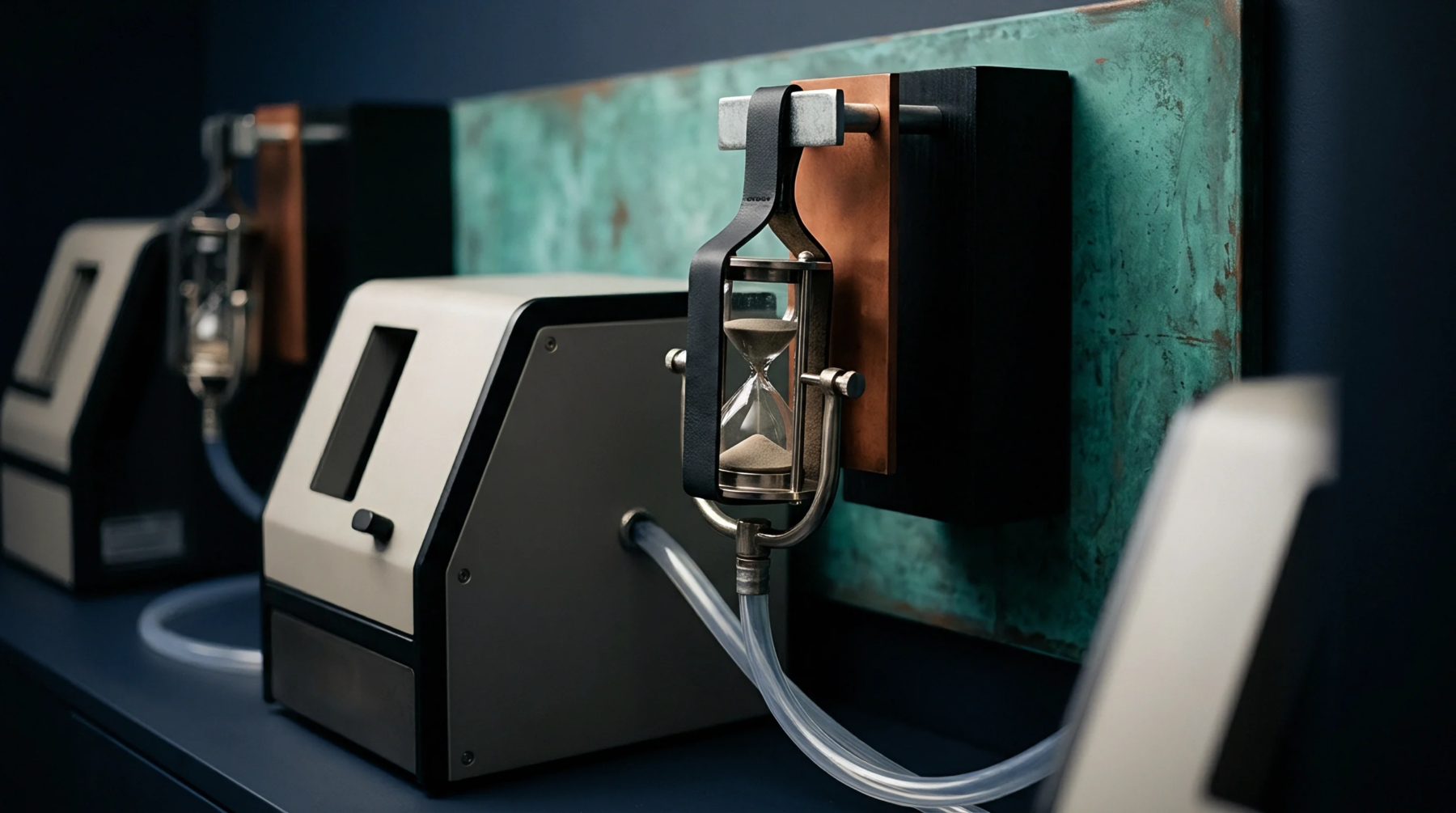
In-Mold Sensor Installation for Real-Time Polymer Gelation Inspection
In-mold dielectric and ultrasonic sensors eliminate conservative press hold timers by triggering part ejection precisely at polymer vitrification.
An analytical observation method confirms the solidification status of cryogenic materials by monitoring the absence of crystalline structures within a substance. This vitrification detection identifies whether a sample has reached an amorphous state instead of a damaging crystalline form through rapid thermal cooling. It governs the verification of structural integrity in biological specimens or industrial polymers during extreme temperature transitions.
The application stops where the sample maintains sufficient thermal conductivity to allow accurate sensor feedback or when the geometry of the material prevents the transmission of required acoustic or optical signals. Establishing the thermodynamic state of vitrification detection ensures the preservation of cellular architecture or polymer chains against the structural disruption typically caused by internal ice formation during freezing operations.
Monitoring ensures that the cooling rate matches the required threshold to prevent phase transitions into solid ice. Engineers apply vitrification detection to confirm that the cooling apparatus remains within the specific operational envelope required for glass formation. A pilot result indicates the feasibility of the process within a controlled laboratory environment while a production yield confirms that the full scale equipment maintains this state consistently across diverse volumes.
If a sensor reports failure, the operator determines whether the capacity for cooling exceeds the capability of the material to reach an amorphous state. Premature application of the measurement often results in excessive energy consumption or potential thermal shock to the material. Maintaining precise control during this phase allows organizations to verify that each unit reaches the required glass transition temperature before further handling occurs.
Variations in cooling media pressure alter the efficiency of the transition process for each batch. Vitrification detection operates by measuring the specific heat capacity change as the liquid turns into a solid without ordering its molecules. High variability in raw material composition forces adjustments to the cooling curve to avoid hidden crystallization.
Capability represents the maximum rate at which a cooling system can force a sample into the glass state. Capacity represents the quantity of units processed simultaneously without violating the temperature constraints required for success. A supplier forecast provides an estimate of performance, but the demonstrated rate recorded by instrumentation shows the actual reliability of the equipment under load.
Distinguishing between these two metrics prevents overestimation of output when processing materials with high thermal inertia or uneven surface contact.
Systemic verification of the phase state provides the data necessary for quality assurance during mass production of sensitive compounds. Vitrification detection functions through non destructive testing that identifies shifts in refractive index or changes in sound wave attenuation as the medium hardens. Early identification of phase instability reduces waste by flagging non compliant batches before the final packaging phase occurs.
Automated inspection systems perform this audit continuously to ensure that no crystalline zones exist within the frozen mass. These systems rely on constant calibration against reference samples to maintain precision in high throughput environments. Correct calibration allows the diagnostic hardware to detect the microscopic onset of crystallization before the material loses its intended structural properties.
The implementation of this technology ensures consistency in the output of materials requiring rapid cooling for structural preservation.
In-mold dielectric and ultrasonic sensors eliminate conservative press hold timers by triggering part ejection precisely at polymer vitrification.
Expertise is a utility, not a secret. sentiention™ publishes its working knowledge as open reference: intelligence layer covering the materials it sources, the markets it enters, and the reference that serves both.