Assay Sampling Protocols for Industrial Metal Scrap Valuation
Assay sampling protocols establish true dry weight and payable metal content, directly governing settlement values, working capital allocations, and lender borrowing base limits.

Moisture
Industrial scrap pricing starts at the weighbridge, but scale weight rarely equals payable metal. Heavy scrap ~ like shredded auto stock, copper chops, stainless turnings, or spent catalyst residue ~ holds onto free water, coolant, and volatile oils. Settling on gross weight without adjusting for moisture erodes cash margins against dry-weight assay tables.
On a 40,000 kilograms load of wet copper turnings carrying 4.5 percent free moisture, 1,800 kilograms of that total is simply water. With copper at 8,200 USD per metric ton, missing that moisture gap writes off 14,760 USD on the purchase ledger before accounting for any actual metal recovery loss.
Catching moisture requires sampling the moment a load hits the receiving yard. Yards typically run mechanical augers, hydraulic grabs, or pull manual increments across a grid over the truck bed. Samples must follow ISO 13909 or ASTM E877 standards so water settling at the bottom of the trailer isn’t missed.
Liquids stratify quickly, and pulling samples from just the top layer during rainy weather or humid hauls can understate total moisture by as much as 60 percent.

Primary Sampling Increments and Gross Moisture Loss
Getting a fair sample out of mixed scrap comes down to particle size. For scrap with pieces up to 50 millimeters, a 50-ton lot requires an aggregate sample of over 250 kilograms. Increments must go straight into sealed, vapor-tight containers so moisture doesn’t evaporate before the lab weighs the material.
Lab moisture testing tracks weight loss through controlled drying. The sample is weighed on a calibrated scale, then dried in forced air at 105 degrees Celsius until the weight stabilizes. But when scrap is coated in machining lubricants or soluble oils, hot drying bakes off hydrocarbons as well, artificially inflating the moisture reading.
Two-stage drying avoids this by driving off free water at 40 degrees Celsius first, then isolating oil loss through solvent extraction or thermogravimetric testing.
Thermal drying below volatile breakdown thresholds prevents organic oil loss from skewing dry weight calculations.
Water retention depends heavily on scrap geometry. Loose heavy melting scrap sheds water easily, whereas fine aluminum borings and wet brass turnings trap water in tight voids through capillary action. The table outlines how moisture retention, required sample sizes, and financial exposure vary across major scrap categories.
Sampling errors at the receiving bay go straight to the bottom line. When turnarounds get busy, yard crews often ditch grid sampling for quick top-skimming or single-point scoops. Those shortcuts skew the sample and distort what is actually paid per unit of metal.
- Top Layer Bias underestimates moisture by gathering wind-dried scrap from the surface while heavy liquids stay pooled at the trailer bed.
- Auger Fine Extraction over-samples micro-fines that hold trapped water, artificially raising calculated lot moisture and leading to excessive seller penalties.
- Unsealed Container Evaporation lets moisture escape during the trip from scale to lab, under-reporting water mass on settlement sheets.
- Thermal Overheating burns off synthetic oils above 110 degrees Celsius, treating lost lubricant as evaporated water and miscalculating true metal weight.
Drying gives the true dry weight baseline, or bone-dry factor. During one wet winter quarter, a buyer applied a flat 3 percent moisture deduction across incoming brass turnings. Audits later showed actual lot moisture ranged from 1.2 percent to 6.8 percent.
Flat-rate deductions create adverse selection: suppliers with dry material take their loads elsewhere, while those with soaked scrap keep sending it in, draining cash on unbilled water weight.
Moisture build-up occurring en route during heavy rain causes dock measurements to reflect weather conditions rather than scrap quality.
Split
Cutting a 250-kilogram raw scrap sample down to a 100-gram analytical pulp takes controlled crushing and splitting. Chemical assays cannot run on raw, lumpy scrap until particle size is consistent; attempting to melt or dissolve coarse scrap directly produces erratic assays because precious metals concentrate unevenly in alloys or plating layers.
Preparation starts with primary crushing. Heavy-duty manganese jaw crushers break down large turnings and bulky fragments to sub-10-millimeter sizes. Ductile items like copper wire or aluminum foil are treated with liquid nitrogen during cryogenic grinding to make them brittle, preventing soft metal from smearing or melting onto the mill walls.

Particle Size Reduction and Sub-Sampling Variance
Splitting relies on mechanical dividers to take human bias out of the loop. Riffle splitters, rotary dividers, and manual cone-and-quartering methods all break down crushed scrap into representative portions. Rotary dividers give far lower variance than manual riffle splits because they stream material continuously over spinning chutes, cutting identical fractions with relative standard deviations under 0.5 percent.
Gy’s sampling theory defines how particle size, sample mass, and sampling error interact. Shrinking the sample mass without shrinking particle size drives fundamental sampling error up exponentially. How fine material must be ground before final pulverization below 75 microns depends on the liberation size of the target metals.
Sub-sampling strategies have to match physical material behavior. Brittle materials flow and divide cleanly, but soft, malleable turnings clump together, causing severe elemental segregation as they hit the splitting chutes. Table 1 compares common reduction methods across primary operational metrics.
| Reduction Method | Suitable Material State | Mass Reduction Ratio | Relative Variance (%) | Operating Cost per Ton |
|---|---|---|---|---|
| Rotary Sample Divider | Dry, crushed sub-10mm fines | 8:1 to 64:1 | 0.35 | 18.50 USD |
| Multi-Stage Riffle Splitter | Free-flowing dry granules | 2:1 per stage | 1.20 | 6.20 USD |
| Cryogenic Ring Mill | Ductile turnings and wire chops | 100:1 to pulp | 0.15 | 45.00 USD |
| Manual Cone and Quarter | Coarse, non-uniform bulk scrap | 4:1 | 3.80 | 2.10 USD |
Fine pulverization is the final mechanical step before wet chemistry or fire assay. Ring-and-puck pulverizers reduce split samples to 200-mesh pulp. Because bowl wear can introduce traces of iron, chromium, or nickel, labs run quartz sand cleaning blanks between sample batches to clear out carryover contamination.
Gy’s sampling theory shows that halving top particle size drops fundamental sampling error by a factor of eight.
Complex electronic scrap and precious metal turnings often require induction melting instead of mechanical splitting. Shredded material is melted in a high-frequency furnace with flux, separating into a clean metal bath and a slag layer. Pulling pin samples directly from the liquid or quenching the melt into chilled water shot removes particle segregation issues entirely.
Sample division follows a strict step-by-step sequence to maintain analytical integrity across split fractions.
- Dry the primary bulk sample in a forced-air oven at 105 degrees Celsius to constant mass.
- Pass dried scrap through a heavy-duty jaw crusher set to a 5-millimeter discharge gap.
- Feed crushed material into a rotary sample divider to draw a representative 10 percent sub-sample.
- Pulverize the sub-sample cryogenically with liquid nitrogen cooling.
- Sieve the ground pulp through a 75-micron screen, weighing any oversized metallic fraction left on the screen.
- Split the sub-75-micron pulp into three equal 100-gram analytical packets using a micro-rotary divider.
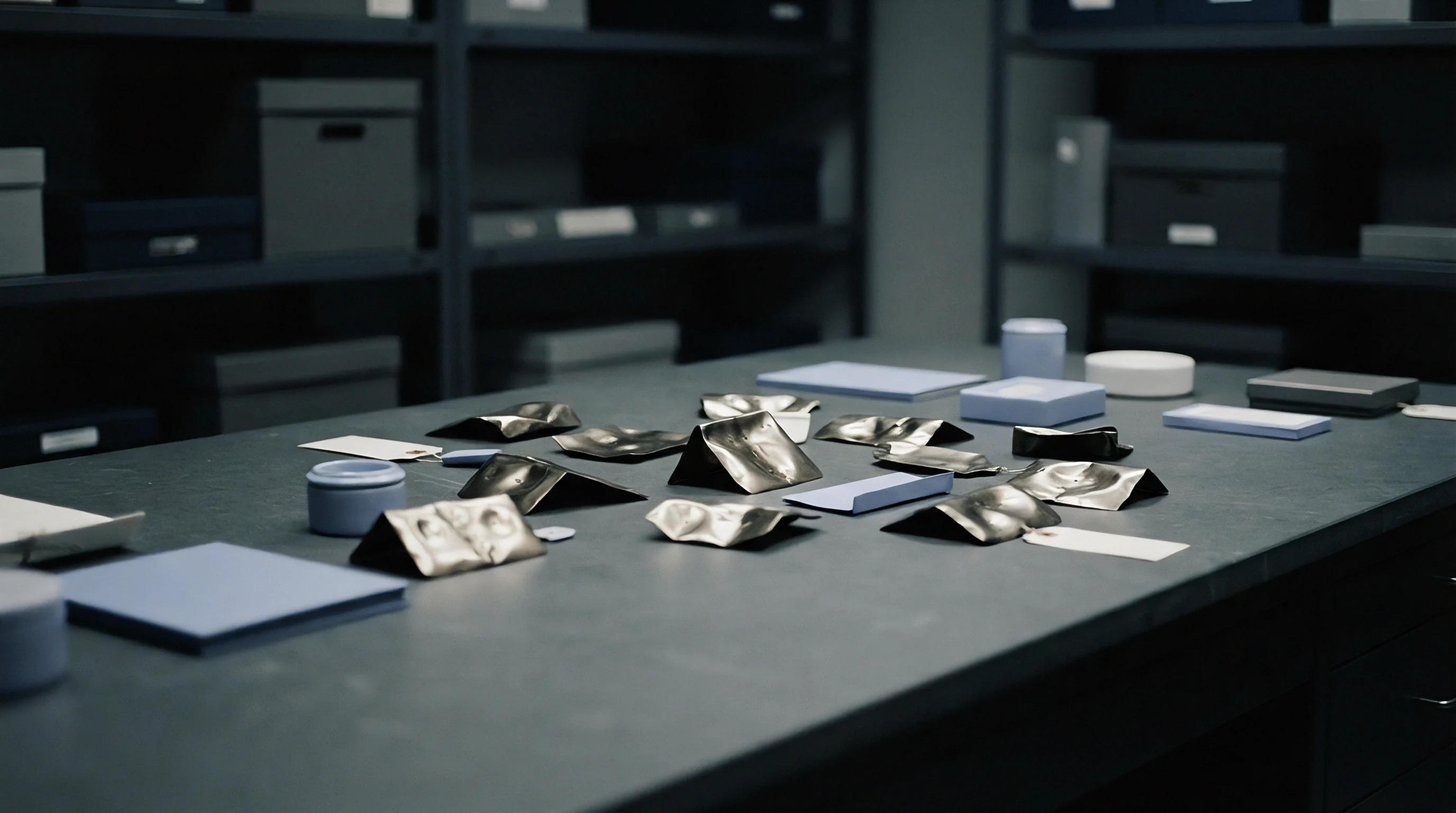
- Vacuum-seal each packet in moisture-barrier foil bags with barcoded tracking labels.
Flawed sample division quietly corrupts laboratory packets. Poor grinding or incorrect sieving traps coarse precious metal flakes in discarded fractions, driving reported values down. A processing plant took a 38,000 USD hit on a single platinum-group catalyst lot when an uncalibrated manual riffle splitter dumped dense platinum particles into the reserve bag and sent light alumina dust to the primary assay sample.
The initial lab reported 1,400 grams per ton platinum, but complete remelting later established the true lot average at 1,820 grams per ton.
Wear on pulverizer rings and jaw plates adds trace iron and manganese to fine pulps, requiring background subtraction corrections on final assay reports.

Flux
Assaying converts ground physical samples into financial valuation data. Choosing the right method depends on the base metal, expected concentrations, and matrix complexity ~ typically using ICP-OES, XRF, wet titration, or fire assay. Using the wrong protocol for a complex matrix leads to incomplete acid digestions, spectral line overlap, or miscalculated metal values.
Fire assay remains the reference method for precious metals like gold, silver, platinum, and palladium. The ground sample is mixed with a flux charge of litharge, soda ash, borax, silica, and an organic reducer like flour or cornstarch. Flux ratios must balance the acidity or alkalinity of the sample matrix: high-alumina catalyst scrap requires basic fluxes heavy in soda ash, whereas silicate slags or electronic boards need acidic flux mixes higher in borax and litharge.

Pyrometallurgical Fire Assay and Spectrometric Quantification
Furnace fusion runs between 1,000 and 1,150 degrees Celsius. Litharge reduces to lead droplets that scavenge precious metals from the liquid slag and sink to the crucible bottom. The recovered lead button is then cupelled in porous magnesia at 950 degrees Celsius, absorbing lead oxide into the cupel wall while leaving behind a clean metal bead of gold, silver, and platinum-group metals.
Parting uses nitric acid to separate silver from gold and platinum-group metals. Silver dissolves into solution while gold remains as a solid residue. For complex PGM samples, micro-beads are dissolved completely in aqua regia and measured by ICP-MS to quantify individual platinum, palladium, and rhodium levels.
ISO 11426 mandates adding proof gold during fire assay cupellation to correct for furnace volatilization losses.
Base metal materials like copper alloys, nickel superalloys, and zinc dross rely on acid digestion analyzed via ICP-OES or atomic absorption. Calibration standards must match the sample matrix to eliminate ionization interferences caused by high background levels of iron, copper, or aluminum. Table 2 summarizes testing standards, detection limits, and precision across primary scrap matrices.
| Target Element | Scrap Matrix Type | Primary Assay Protocol | Detection Limit | Analytical Precision (% Relative) |
|---|---|---|---|---|
| Gold / Silver | Electronic scrap, connector pins | Lead fusion fire assay with gravimetric finish | 0.10 g/t | 0.25 |
| Platinum / Rhodium | Spent auto catalysts | NiS fire assay followed by ICP-MS | 0.05 g/t | 0.50 |
| Copper / Zinc | Brass and bronze turnings | Electro-gravimetry / EDTA titration | 0.01 % | 0.10 |
| Nickel / Cobalt | Superalloy turbine scrap | Multi-acid digestion with ICP-OES | 0.005 % | 0.30 |
| Aluminum / Silicon | Cast aluminum turnings | Wavelength dispersive XRF (fused bead) | 0.02 % | 0.40 |
Handheld XRF units provide fast screening at the receiving bay, but handheld readings should never serve as final settlement assays. Surface oxidation, metal segregation, and shallow X-ray penetration under 50 microns generate strong surface bias. Handheld XRF regularly over-reports precious surface plating while missing internal iron cores inside copper busbars or deeper contamination.
Getting full dissolution during acid digest is critical. Refractory matrices and mineral oxides require microwave multi-acid digestions using hydrofluoric, nitric, perchloric, and hydrochloric acids. Hydrofluoric acid breaks down tough silicates, unlocking tiny precious metal inclusions that standard aqua regia leaves behind.
Spectral interferences in optical emission spectroscopy can alter line intensities and trigger false positives on minor elements. For example, cobalt lines overlap iron spectra at specific wavelengths, forcing labs to switch to alternative emission lines or program inter-element correction factors into calibration software.
Inter-laboratory round-robins frequently uncover systematic gaps between buyer and seller numbers. What specific chemical interference causes aqua regia extractions to consistently under-report rhodium in spent catalysts compared to total matrix fusion?

Discrepancy
Commercial scrap sales agreements lay out exact procedures for resolving assay gaps between buyer and seller labs. When assay results differ beyond agreed tolerance limits, the trade moves into formal dispute resolution. Contractual tolerance thresholds ~ called splitting limits or exchange limits ~ account for normal testing variance and define when a difference is routine noise versus a material disagreement.
If buyer and seller assays fall inside the splitting limit, the deal settles on the straight arithmetic mean. For instance, if a copper cathode scrap agreement sets an exchange limit of 0.20 percent copper, and the buyer reports 99.10 percent while the seller reports 99.25 percent, the 0.15 percent difference falls inside the threshold. The lot settles at 99.175 percent copper.

Commercial Exchange Limits and Umpire Arbitration
When the gap exceeds the exchange limit, dispute provisions trigger the third sealed sample packet: the umpire. This sealed pulp goes to an independent, accredited referee laboratory named in the master agreement. The referee lab runs the assay blind, without knowing either party’s original results.
Contract terms dictate how the final payable figure is picked from the three available assays. Most contracts use either middle-assay or true-umpire rules. Under middle-assay rules, settlement takes the middle figure of the three, throwing out the extreme outlier.
Under true-umpire rules, if the referee result falls between buyer and seller assays, the umpire figure is binding; if it lands outside their spread, settlement defaults to whichever party was closest to the umpire.
Table 3 shows a financial post-mortem on a 100-metric-ton copper-gold scrap lot, illustrating how assay variance, splitting limits, and settlement rules shift final cash payouts.
| Assay Parameter | Buyer Assay | Seller Assay | Assay Delta | Exchange Limit | Umpire Assay | Settlement Rule | Final Payable Metal | Net Cash Delta (USD) |
|---|---|---|---|---|---|---|---|---|
| Copper Grade (%) | 85.20 | 86.80 | 1.60 % | 0.50 % | 86.10 | Middle Assay | 86.10 % | + 6,750 USD vs Buyer |
| Gold Grade (g/t) | 42.00 | 48.00 | 6.00 g/t | 1.00 g/t | 41.50 | Closest to Umpire | 42.00 g/t | 0 USD vs Buyer |
| Moisture Content (%) | 3.50 | 1.20 | 2.30 % | 0.30 % | 3.10 | True Umpire | 3.10 % | – 14,040 USD vs Seller |
| Silver Grade (g/t) | 310.00 | 315.00 | 5.00 g/t | 8.00 g/t | N/A | Mean Average | 312.50 g/t | + 2,000 USD vs Buyer |
Umpire laboratory fees are paid by the losing party or split, depending on contract terms. A typical clause charges full costs to whichever party pitched furthest from the referee result. That cost penalty discourages buyers or sellers from submitting aggressively biased initial assays to push the middle average in their direction.
Managing contract risk requires precise language around exchange limits and arbitration steps. Risk-conscious operators explicitly write operational triggers into purchase agreements:
- Splitting Limit Definition defines exact percentage variances that automatically send samples to referee testing without requiring separate agreement.
- Referee Laboratory Pre-Selection names three ISO 17025 accredited labs in advance, heading off selection delays during volatile price swings.
- Umpire Fee Assignment requires the party furthest from the referee result to cover all testing and transport costs.
- Chain of Custody Verification rejects referee samples if seal integrity marks show signs of tampering or moisture barrier compromise.
Assay disputes directly hit working capital by extending settlement times, tying up receivables, or leaving unhedged positions exposed to market shifts. Provisional payments bridge that liquidity gap: buyers usually advance 80 to 90 percent of estimated lot value based on scale weights and quick dock assays, settling the remaining balance once final assays or umpire reports clear.
Buyers frequently set an 85 percent provisional payment policy on complex electronic scrap contracts. When an assay dispute arose over a 450,000 USD lot of circuit board shred, referee testing took 11 weeks to resolve. Holding back 15 percent preserved 67,500 USD in working capital while the referee lab finished gold and palladium assays.
Standard metal contracts stipulate that if the difference between buyer and seller assays falls within the splitting limit, the arithmetic mean of the two assays is final and binding for settlement.
Facility
Asset-based credit lines for scrap processors depend heavily on how reliable their sampling and assay data are. Commercial banks and trade lenders advance capital against inventory, but they treat raw scrap stockpiles as unverified assets until physical sampling and lab testing establish actual metal content and net liquidation value.
Lenders adjust borrowing haircuts based on where scrap sits in the assay pipeline. Unsampled, bulk scrap on the yard gets heavy haircuts, with advance rates often capped at 40 to 50 percent of estimated value. Once material passes primary crushing, moisture verification, and certified pulp sampling, lenders will raise advance rates to 75 or 80 percent.
Final refinery receipts backed by settled assays support advance rates up to 90 percent on revolving credit facilities.

Borrowing Base Liquidation Values and Covenant Control
Borrowing base certificates require routine updates tied to certified assay ledgers. Credit agreements include mandatory valuation adjustments if assays get downgraded or moisture runs high. If a bank audit shows yard moisture exceeding reported figures by more than 1.5 percent, the lender can apply a retroactive haircut, instantly squeezing available credit.
Proper borrowing base reporting relies on matching lot assay certificates directly against ERP inventory ledgers. The table below outlines how advance rates step up across different stages of physical preparation and assay verification.
Lender audits routinely include independent sampling of pledged stockpiles. Bank surveyors pull field samples to verify yard ledgers against independent lab assays. Discrepancies between internal yard numbers and bank audit samples can trigger covenant breaches, defaults, or immediate credit line freezes.
The cash conversion cycle in scrap trading hinges on the gap between paying sellers for raw material and collecting settlement funds from smelters. Poor sampling extends that cycle by dragging out dispute resolution and delaying final outturn statements. A two-week delay in assay finalization for a yard handling 10,000,000 USD a month adds roughly 450,000 USD in working capital financing demands at prevailing interest rates.
Letter of Credit transactions demand meticulous analytical paperwork. Drawing down on credit facilities requires clean assay certificates from approved inspection agencies; minor wording errors, omitted moisture figures, or unverified testing methods trigger bank rejections, holding up payment and running up demurrage charges at port.
Trading high volume on thin margins leaves no room for sloppy sampling. Catching moisture at the scale protects gross margin on arrival. Controlled splitting stops sampling bias from corrupting lab pulps.
Precise fire assays and wet digestion establish actual payable metal. Clear splitting limits protect against assay drift. And clean borrowing base reporting turns physical stockpiles into low-cost liquidity to fund buying operations.