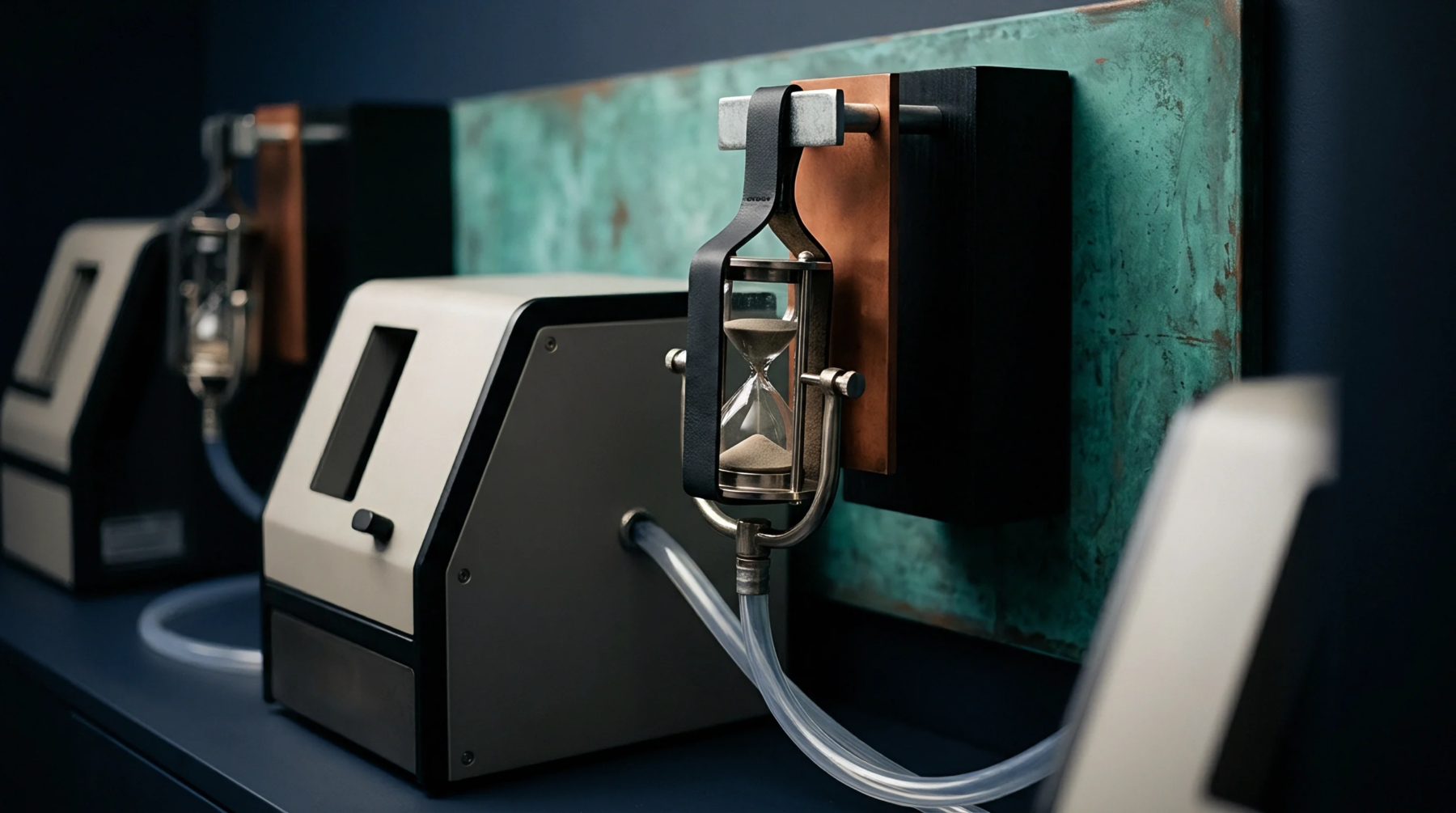
In-Mold Sensor Installation for Real-Time Polymer Gelation Inspection
In-mold dielectric and ultrasonic sensors eliminate conservative press hold timers by triggering part ejection precisely at polymer vitrification.
Electronic manipulation of raw electrical voltages provides the foundational interface for translating delicate physical transducer outputs into usable data formats for industrial control architectures. Signal conditioning represents the adjustment process that prepares weak or noisy inputs for analog to digital conversion. Hardware circuitry performs this task by applying specific electrical transformations to the original wave form before transmission reaches the processor.
Isolation prevents ground loops and hazardous voltage spikes from damaging sensitive controller inputs. Amplification increases the low voltage level produced by thermocouples or strain gauges so the range matches the input window of the data acquisition system. Filtration removes unwanted high frequency noise that obscures valid measurements within the spectral domain.
Linearization corrects non-proportional sensor responses to ensure that output values correspond accurately to actual physical states. The boundary of this function ends where binary conversion starts.
Data integrity relies on how effectively signal conditioning stabilizes raw fluctuations before interpretation begins. Precision hardware shifts DC offsets and scales amplitude ranges to optimize the resolution available to the conversion chip. Calibration audits monitor these adjustments to verify that drift remains within defined tolerances during extended production runs.
Any variation in the conversion chain introduces errors that propagate through the control loop. High input impedance prevents loading effects that would otherwise distort the source voltage. Integrated modules minimize wire lengths to reduce electromagnetic interference picked up between the sensor and the processing block.
Industrial audits measure the performance of this hardware by comparing raw sensor values against the processed output delivered to the controller. A readiness question addresses whether the circuit introduces attenuation or harmonic distortion that hides transient events during the start up phase. Capable hardware delivers consistent resolution across the full scale of the instrument even when thermal conditions vary.
Capacity refers to the throughput limit of the conversion path where higher sampling rates increase the risk of cross channel interference. Demonstrating a stable rate requires testing the interface under simulated electrical noise scenarios. Early failures in this component cause false alarms in the monitoring system that result in unnecessary line stops.
Pilot results provide the baseline for full production rollouts by establishing the signal to noise ratio required for reliable machine operation.
Grounding architectures define the limits of signal conditioning by determining the susceptibility of the loop to external interference. Common mode rejection ratios characterize the ability of the circuit to ignore noise present on both wires of a differential pair. Differential amplifiers suppress these unwanted voltages by subtracting the signal from the reference potential.
Passive components like resistors and capacitors provide basic filtering at a lower cost than active stages. Active stages require an external power supply to maintain signal integrity during long cable runs. Output buffers drive the processed voltage across shielded cabling without dropping the amplitude.
Proper implementation ensures that the final digital reading accurately represents the physical reality of the monitored system.
In-mold dielectric and ultrasonic sensors eliminate conservative press hold timers by triggering part ejection precisely at polymer vitrification.
Expertise is a utility, not a secret. sentiention™ publishes its working knowledge as open reference: intelligence layer covering the materials it sources, the markets it enters, and the reference that serves both.