Meaning
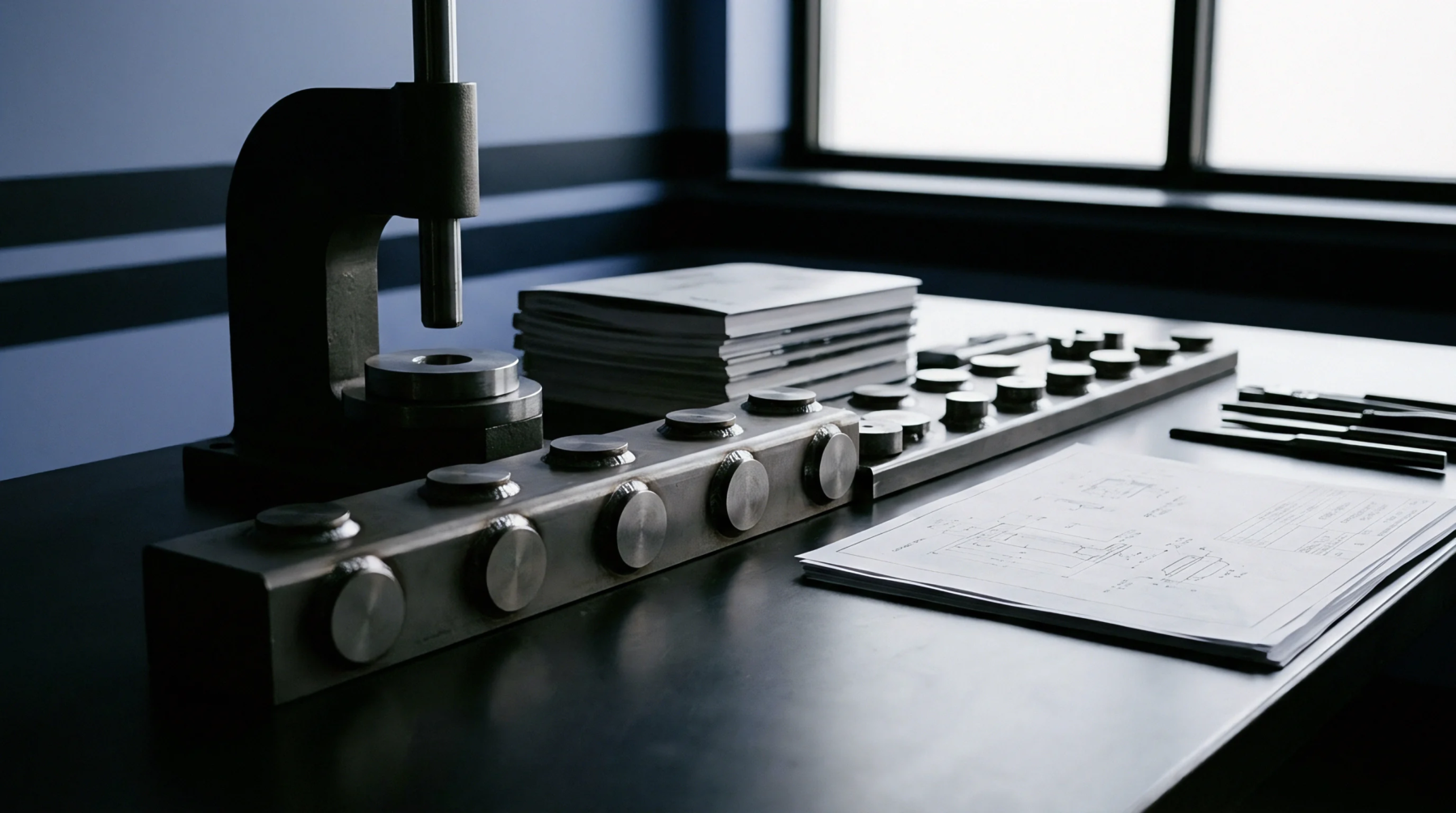
A metal fabrication tool moves a continuous strip of sheet metal through a series of stations to perform multiple distinct operations in a single stroke cycle. This progressive die transforms raw coil stock into a finished or semi-finished component by executing sequential cuts, bends, and forming actions as the material advances. It functions by synchronizing the stroke of the press with a mechanical feed mechanism that dictates the pitch of each interval.
Tooling Sequence
The internal architecture of the apparatus divides the production requirements into incremental steps arranged along a horizontal axis. A pilot pin or similar locating feature secures the position of the metal strip during each pause to maintain tight dimensional tolerances between successive operations. Punching stations remove excess material while secondary stages deform the remaining geometry to meet precise engineering specifications.
This arrangement minimizes handling requirements and allows high-speed production cycles that exceed the capability of discrete transfer stations.
Production Economics
The initial investment for this equipment remains significantly higher than simpler tooling because of the complexity involved in building multiple synchronized stations into one shoe. Unit costs drop as output volume rises due to the reduction in cycle time and the elimination of manual workpiece transfer. Maintenance demands increase with the number of stations because a failure in a single punch or insert necessitates the removal of the entire assembly from the production line.
A facility must demonstrate sufficient order stability to justify the setup time and the cost of the dedicated hardware.
Capacity Alignment
Performance measurements focus on the consistency of the output compared against the specified dimensional variance allowed by the component print. Throughput metrics track the number of finished parts generated per hour against the mechanical cycle speed of the press. This hardware requires precise synchronization between the feed speed and the ram stroke to prevent buckling or material misalignment.
A high-speed progressive die configuration achieves lower part costs through automation while requiring greater technical rigor during the design and initial validation phase.