Meaning
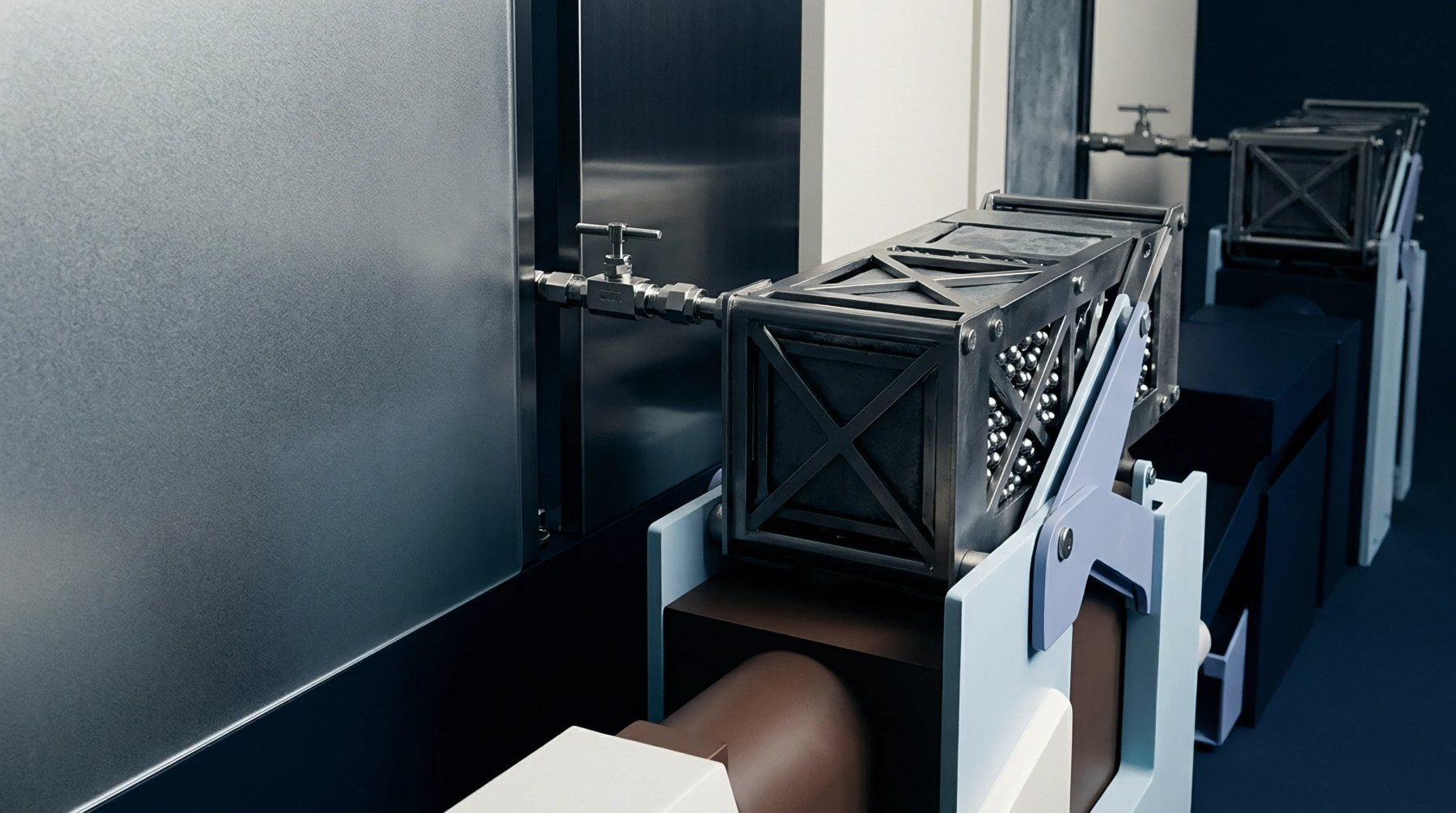
Gravity flow regimes in storage vessels dictate the uniform movement of bulk solids during discharge. Achieving hopper mass flow requires every particle of the material to remain in motion whenever any is discharged. This uniform descent eliminates stagnant zones and reduces the risk of material degradation or structural loading imbalance.
It represents the preferred flow pattern for cohesive powders that tend to consolidate during storage.
Boundary Friction
Surface roughness on the internal walls of the container dictates the pattern of material movement. When particles slide along the hopper walls, the resulting friction must not exceed a critical limit that causes the material to shear within itself. Wall liners made of smooth fluoropolymer or polished stainless steel are often installed to reduce this sliding resistance.
Lower wall friction promotes a transition from stagnant funnel flow to steady, continuous descent. The angle of the hopper cone must be sufficiently steep to overcome this friction for a given material and wall combination. Inadequate steepness or high friction leads to funnel flow, which results in erratic discharge rates and severe material segregation.
Velocity Distribution
Discharging material at a uniform rate across the entire cross-section stabilizes the process output. During hopper mass flow, the vertical velocity of the bulk solid remains relatively uniform across the width of the silo, preventing the formation of central core flow. This consistent velocity profiles prevent segregation by remixing particles that separated during the filling stage.
The result is a highly predictable discharge rate that supports downstream blending and feeding operations.
Stress Field
Consolidation forces within the hopper change during discharge. The stress field transforms into a dynamic radial pattern. This distribution keeps compressive forces low near the outlet, preventing stable arches from halting flow.