Mechanical Splitting Bias and Sample Variance in Dense Ferrous Material
Mechanical sub-sampling bias in dense iron cargo shifts moisture and Fe assays, altering landed valuation and compressing borrowing base covenants.

Chute
When high-density iron ores and direct reduced iron fines are split under gravity, mass segregation severely complicates sub-sampling. Particles with a specific gravity between 4.8 and 7.2 grams per cubic centimeter accelerate much faster down inclined slides than silica or alumina gangue minerals near 2.6 grams per cubic centimeter. Differential friction along the splitter surface worsens the effect, forcing heavy iron oxide grains to the bottom of the flowing material bed and layering the stream by density.
As a bulk particulate stream clears the lip of a division hopper, momentum separates particles according to mass and cross-sectional drag. Dense specular hematite and magnetite fines hold their forward velocity along a tight central vector, while lighter tailing minerals drift outward toward the edges of the discharge curtain. Fixed collection slots on static splitters end up capturing non-representative fractions whenever this stream strays from symmetry.

Physical Trajectories of High Specific Gravity Particles
Dense minerals falling under gravity behave nothing like uniform, low-density powders. Heavy grains drop faster through the air, and coarse, dense lumps carry enough kinetic energy to bounce off internal baffle plates, scattering high-grade iron particles unevenly into outer collection slots. In static chute splitters, this kinetic rebound skews iron content between paired sample boxes long before samples reach chemical reduction.
- Stream Acceleration Variations cause high-density iron particles to overshoot receiving slots while light silica drops vertically into rejected fractions.
- Vibratory Feed Stratification concentrates fine magnetite dust at the bottom of the feed tray, discharging enriched heavy fractions into initial sub-samples.
- Electrostatic Moisture Binding holds wet micro-fines against tray walls until sudden mass release alters the moisture profile of final laboratory aliquots.
- Cutter Edge Reflection deflects coarse specular hematite lumps into the main waste channel, depressing perceived lump-to-fines ratios.

Moisture Entrapment and Sub-Sampling Stratification
Retained liquid within fine particulate matrices alters extraction mechanics at every sub-sampling step. Free moisture coats particle surfaces, forming liquid bridges that bind fine iron ore dust into dense agglomerates that resist division during mechanical splitting and pass into single channels as intact masses. At the same time, surface evaporation during high-energy vibratory feeding lowers measured moisture percentages in final aliquots, distorting the net dry quantity calculated for commercial settlement.
Physical separation during stream transition introduces systemic deviation before chemical analysis occurs.
Failing to control density segregation during primary stream division systematically skews iron grade determinations, leaving receiving facilities exposed to unpaid material losses across bulk vessel deliveries.


Partition
The statistical distribution of mineral species dictates the variance inherent in sub-sampling dense ores. Pierre Gy established that extraction error scales directly with particle size, material density, and liberation factors. In dense ferrous commodities, high iron content combined with elevated particle mass pushes fundamental sampling error well above that of industrial minerals with equivalent size distributions.
Because sample mass governs statistical variance and particle size defines liberation factors, cutting sample mass without first reducing particle size spikes fundamental sampling variance, leading to unpredictable assay swings between duplicate split samples taken from the same lot.

Quantifying Fundamental Sampling Error in High Density Solids
Gy’s theoretical framework shows that fundamental sampling error variance depends on the sampling constant, nominal top particle size, and sample mass. For hematite and direct reduced iron pellets, the high density of the iron-bearing mineral phase inflates the mineralogical constitution factor within the sampling constant equation, so drawing a sub-sample of inadequate mass introduces variance that no laboratory analytical technique can eliminate.
Small errors compound rapidly across bulk tonnage. A primary increment taken from a conveyor belt carries its own statistical uncertainty, to which subsequent mechanical splitting stages add secondary and tertiary extraction variances. Because these variances accumulate additively, operating secondary splitters with improper aperture widths or excessive cutter speeds can make secondary sampling variance exceed the primary extraction variance, invalidating the sample preparation audit trail.
| Material Type | Nominal Top Size (mm) | Mineral Density (g/cm³) | Critical Sample Mass (kg) | Fundamental Sampling Variance (%) |
|---|---|---|---|---|
| Specular Hematite Lump | 31.5 | 5.26 | 125.0 | 0.042 |
| Sinter Feed Fines | 6.3 | 4.80 | 12.5 | 0.018 |
| Magnetite Concentrate | 0.15 | 5.18 | 0.05 | 0.003 |
| Direct Reduced Iron Pellets | 16.0 | 3.50 | 28.0 | 0.029 |
These variance figures demonstrate how sample mass requirements depend exponentially on nominal particle size. Coarse iron ore lump requires substantial primary sample masses to keep fundamental sampling error within acceptable operational bounds; passing uncrushed lump through a mechanical splitter introduces heavy extraction variance that can generate false quality claims during invoice auditing.
A sample mass below four kilograms for twenty millimeter iron ore lump generates a fundamental sampling variance exceeding zero point forty-five percent iron by weight.
The exact threshold where micro-segregation overrides mechanical division mechanics in ultra-dense iron concentrates remains subject to ongoing empirical verification across automated sampling towers.

Riffler
Mechanical division hardware designed for geological samples frequently founders on heavy industrial minerals. Stationary Jones riffle splitters rely on manual material presentation across a bank of alternating chutes, where human variation in pour speed, angle, and tray alignment introduces systematic sub-sampling error. Rotary tube and rotary pan splitters remove manual placement bias by traversing the falling stream at constant velocity.
How Do High Density Fines Distort Mechanical Splitting?
Fine iron ore dust under one hundred microns presents unique fluidization characteristics during stream splitting. Air currents generated by falling dense particles blow light gangue fines away from split collection chutes, leaving receiving vessels enriched in heavy iron phases. Rotary splitters operating within dust-tight enclosures mitigate air-current displacement, maintaining correct particle size distribution across both sample halves.
Because magnetite particles aggregate under residual magnetic fields and cutter speeds dictate extraction integrity, mechanical extraction demands constant stream velocity. ISO 3082 specifies that primary and secondary sample cutters must traverse falling material streams at a uniform velocity not exceeding 0.6 meters per second. Exceeding this speed threshold causes dense particles to hit the leading edge of the cutter blade and deflect outward, systematically excluding coarse iron fractions from the collected increment.
- Clean all splitter chutes and hopper walls using non-magnetic brushes to remove residual magnetite dust from prior splits.
- Verify tray slope alignment using a digital level to ensure uniform material presentation across all discharge slots.
- Pour the dense sample evenly along the entire length of the feed hopper at a controlled rate not exceeding two kilograms per second.
- Collect both sub-sample buckets, weigh each increment immediately, and reject the division if split mass parity deviates by more than one point five percent.
Aperture width design governs physical sample inclusion. Riffle chute widths must measure at least three times the nominal top size of the material being divided, with an absolute minimum width of ten millimeters for fine iron ores. Narrow chutes bridge rapidly when exposed to high-density fines carrying moisture, causing material to back up in the feed hopper and forcing flow through a limited subset of open chutes, which introduces severe extraction bias.
Rotary division of dense particulate streams eliminates operator bias where static chutes fail.
Stationary slot divisions achieve acceptable precision on heavy concentrates provided manual feeding remains steady across the entire hopper width.

Valuation
Financial balances reflect material quality determinations. A systematic bias in sample splitting translates directly into balance sheet adjustments, altering inventory value and cash settlement figures. International commercial contracts for dense iron materials establish pricing based on dry metric tonne unit values, where a fraction of a percent deviation in reported total iron content shifts payment obligations by tens of thousands of dollars per shipment.
Assay deviations alter credit availability, while moisture bias shifts net dry tonnage. When sampling errors bleed into invoice settlements, unreconciled variances erode net working capital and force inventory write-downs that compress operational margins.
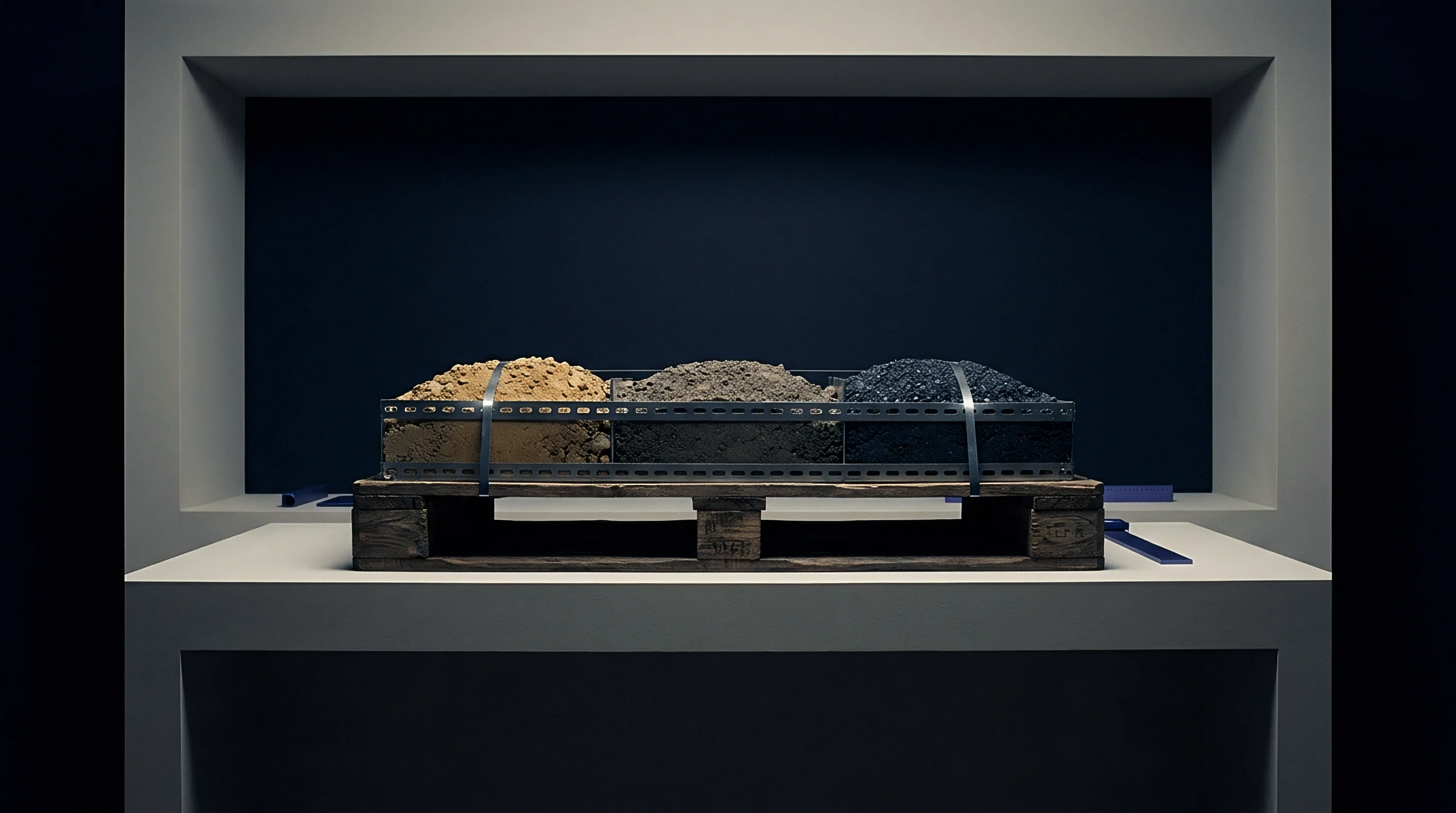
Financial Cascade of Assay Deviations on Credit Facilities
Discrepancies in total iron content propagate directly through commercial settlement equations. Consider a 50,000 dry metric tonne cargo of iron ore sinter feed priced at a benchmark rate of $110.00 per dry metric tonne for 62.00% Fe grade, with a contract penalty clause of $1.50 per dry metric tonne unit below benchmark grade. A negative mechanical splitting bias of 0.40% Fe in the final laboratory sub-sample results in a reported grade of 61.60% Fe.
| Parameter | Target Metric | Biased Sub-Sample Assay | Variance per Tonne | Net Cash Impact ($) | Borrowing Base Effect |
|---|---|---|---|---|---|
| Total Iron Content (%) | 62.00 | 61.60 | -$0.60 / DMT | -$30,000.00 | Reduces collateral value by 0.55% |
| Free Moisture Content (%) | 3.00 | 2.00 | +515.5 DMT (billable) | +$56,700.00 | Distorts dry weight calculations |
| Silica Impurity (SiO₂) (%) | 3.50 | 4.10 | -$0.90 / DMT | -$45,000.00 | Triggers secondary penalty tier |
| Landed Value ($/DMT) | $110.00 | $108.50 | -$1.50 / DMT | -$75,000.00 | Tighter debt covenant headroom |
Physical sub-sampling bias creates direct financial losses, and moisture errors introduce parallel exposure. If high-energy vibratory splitting causes a 1.00% moisture loss prior to laboratory oven drying, the reported moisture drops from 3.00% to 2.00%. The seller then bills the buyer for 515.5 additional dry metric tonnes of non-existent mineral mass, leaving the buyer paying $56,700.00 for water recorded as dry iron ore and inflating the landed unit cost of raw material inventory.
Inventory valuation under international accounting standards requires recording stocks at the lower of cost and net realizable value. When mechanical sub-sampling errors obscure the true chemical composition of stored raw materials, collateral audits for asset-backed inventory facilities yield unexpected write-downs. Because lenders calculate borrowing bases using verified cargo assays, a sudden downward revision in inventory iron grade during a covenant verification audit reduces available facility drawdowns, tightening liquidity during peak production cycles.
- Independent Inspection Mandates specify automated mechanical rotary samplers compliant with ISO 3082 at the loading port to bind both counterparty ledgers.
- Dual Sample Retention Protocols secure sealed reserve splits for umpire laboratory arbitration whenever buyer and seller assays diverge beyond zero point three Fe units.
- Moisture Tightness Verification requires hermetically sealed split collection vessels to prevent evaporation losses during sample reduction steps.
- Borrowing Base Adjustments recalculate available trade credit lines using the lower bound of a two-sigma sample variance interval rather than point-estimate assays.
Trade finance lenders providing documentary credit facilities mandate clear sampling verification trails. Unresolved sample variance introduces legal uncertainty into letter of credit drawdowns; when buyer and seller sampling records conflict, bank payment releases stall, incurring demurrage costs at port terminals and consuming operational headroom under working capital facilities.
Contractual clauses specifying final settlement on loading port automated rotary samples eliminate buyer exposure to discharge port split degradation.
Standard international iron ore sale agreements incorporating ISO 3082 referee provisions restrict quality price adjustments strictly to split variances exceeding agreed analytical tolerances.

Dispute
Commercial contracts for bulk raw materials rely on contractual tolerance limits to govern quality disputes and establish finality. When buyer and seller laboratory results disagree, technical audits determine whether the variance stems from analytical instrumentation limits or mechanical sub-sampling bias generated during initial sample reduction.

Arbitration Thresholds and Umpire Laboratory Procedures
Reconciling divergent chemical findings between loading ports and receiving terminals demands strict adherence to referee procedures. If the difference between seller loading assays and buyer discharge assays falls within the permissible tolerance defined by ISO 3082, the parties settle on the arithmetic mean of the two results. When split variance exceeds this threshold, a sealed reserve sample split goes to an agreed independent umpire laboratory for definitive analysis.
Mechanical splitters used to prepare umpire reserves must undergo rigorous bias testing under ISO 3082 Annex B protocols. This testing compares paired samples divided by the mechanical splitter against paired reference samples collected manually from a stopped belt. If statistical t-tests reveal significant bias in the mechanical divider at the 95% confidence level, the splitter loses qualification status, and reserve samples divided by that machine are invalidated for arbitration settlement.
When analytical results from split samples fall within the ISO 3082 permissible tolerance of zero point two eight percent Fe, the arithmetic mean of buyer and seller assays determines final commercial invoice settlement.